
CGTMSE Scheme 2026: The Ultimate Guide to Collateral-Free Loans up to ₹10 Crore
Every year, tens of thousands of Indian MSME owners are told the same thing by their bank: "We need collateral to process your loan." For a first-generation entrepreneur running a garment unit in Kolkata or a small engineering workshop in Howrah, that conversation ends the loan before it starts.
The CGTMSE scheme exists specifically to break that deadlock—and in 2026, it covers collateral-free business loans up to ₹10 crore.
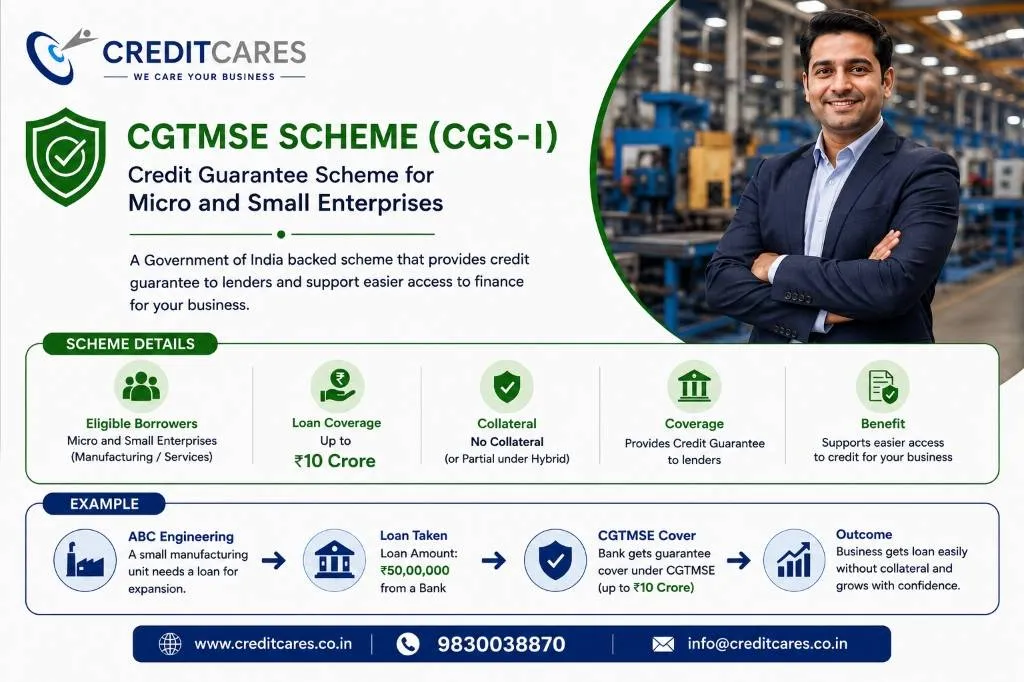
CGTMSE (Credit Guarantee Fund Trust for Micro and Small Enterprises) is a Government of India scheme that enables micro and small enterprises to borrow up to ₹10 crore from banks and NBFCs without pledging property or providing a third-party guarantor. CGTMSE does not lend money directly; it acts as a guarantor to the lending institution, covering 75% to 85% of the loan amount if the borrower defaults. The guarantee fee, revised in April 2025, starts at 0.37% per annum.
Jointly established in August 2000 by the Ministry of Micro, Small and Medium Enterprises and SIDBI, the Trust has since facilitated over 65 lakh collateral-free loan accounts worth more than ₹5 lakh crore in cumulative guarantees. For an MSME that has no fixed assets to mortgage, CGTMSE is often the only route to formal institutional credit.
CGTMSE does not guarantee approval—it reduces the bank's risk exposure. The bank still runs its own credit assessment. Understanding this distinction is the single most important thing an applicant can do before walking into a branch. Most rejections happen not because CGTMSE declined the borrower, but because the bank's internal scorecard flagged the file first.
How does the CGTMSE scheme work?
Under CGTMSE, the MSME applies for a loan at a Member Lending Institution (bank, NBFC, or SFB). The MLI appraises the proposal independently, sanctions the loan if it meets their credit norms, and then—not before—applies to CGTMSE for guarantee cover on behalf of the borrower. The borrower never deals with CGTMSE directly.
Here is how the process works in plain steps:
| Step | Who Acts | What Happens |
|---|---|---|
| 1 | MSME | Approaches a CGTMSE-registered bank or NBFC (MLI) with a business plan and documents. |
| 2 | MLI (Bank) | Evaluates repayment capacity, business viability, and creditworthiness. |
| 3 | MLI | Sanctions the loan under its own credit policy. |
| 4 | MLI | Applies to the CGTMSE portal for guarantee cover and pays the Annual Guarantee Fee. |
| 5 | CGTMSE | Issues guarantee cover to the MLI for the approved percentage. |
| 6 | MLI | Disburses the loan to the MSME—no collateral required. |
| 7 | Default (if any) | CGTMSE reimburses the MLI for the guaranteed portion after NPA declaration. |
As of 2026, over 200 MLIs participate in the scheme—including all scheduled commercial banks, select Regional Rural Banks, Small Finance Banks, and registered NBFCs.
CGTMSE eligibility criteria 2026
To be eligible for CGTMSE cover, a business must be a new or existing Micro or Small Enterprise engaged in manufacturing or services, as defined under the MSMED Act 2006 (as amended in 2020). They must have a valid Udyam Registration Certificate and a clean credit record (no existing NPA with any bank or financial institution).
| Eligibility Factor | Requirement |
|---|---|
| Enterprise category | Micro or Small Enterprise only (Medium Enterprises not covered under CGS-I). |
| Sector | Manufacturing or services—retail trade included (revised post-2023). |
| Registration | Udyam Registration mandatory. |
| Loan type | Term loan, working capital, composite loan (fresh sanctions; top-ups with conditions). |
| Maximum credit exposure | ₹10 crore per borrower (per enterprise, not per promoter). |
| Credit status | No existing NPA with any bank/FI at the time of application. |
| IT PAN | Mandatory for loans above ₹5 lakh. |
| Constitution | Proprietorship, partnership, LLP, private limited company, or other formats permitted. |
Excluded categories: Agriculture (as primary activity), Self-Help Groups (SHGs), Joint Liability Groups (JLGs), wholesale trade beyond prescribed limits, and educational/training institutions.
CGTMSE loan limit and guarantee coverage
The maximum credit facility covered under the CGTMSE scheme is ₹10 crore per borrower, as revised in April 2025 following the Union Budget. This covers term loans, working capital, and composite facilities. For DPIIT-recognised startups, a separate scheme (CGSS) extends this ceiling to ₹20 crore.
Guarantee coverage by borrower category (indicative—verify current slabs on cgtmse.in):
| Borrower Category | Guarantee Coverage |
|---|---|
| Micro enterprises (loan up to ₹5 lakh) | Up to 85% |
| Women / SC-ST entrepreneurs, NER and Aspirational Districts | Enhanced coverage applicable |
| Other MSEs (loan above ₹50 lakh) | 75% of outstanding |
| Hybrid Security model (part-secured loan) | CGTMSE covers unsecured portion up to ₹10 crore |
The Hybrid Security model—introduced in 2018—is worth noting for borrowers who have partial collateral. A bank can accept property to secure part of the loan and route the remaining exposure through CGTMSE. This is often the most practical path for businesses that have some assets but not enough to cover the full loan amount.
Annual Guarantee Fee structure (effective 1 April 2025)
The Annual Guarantee Fee (AGF) was revised downward for all guarantees approved or renewed on or after 1 April 2025. The AGF is charged per annum on the guaranteed amount in the first year and on the outstanding loan balance in subsequent years. The fee starts at 0.37% per annum.
Concessions applicable:
- Women-owned businesses, SC/ST entrepreneurs, ZED-certified units, and units in the North East Region and Aspirational Districts receive a 10% discount on the standard AGF.
- MLIs with better portfolio risk profiles may receive a 10% discount; higher-risk MLIs may attract a risk premium of up to 70% above the standard rate.
- Whether the AGF is passed on to the borrower or absorbed by the lender is the lender's decision—confirm this in your sanction letter before signing.
Always verify the current fee slab for your loan size directly on cgtmse.in or through your lender, as fee structures are periodically revised.
Documents required for a CGTMSE loan
Documents are submitted to the bank or NBFC, not to CGTMSE. Here is the standard checklist:
Identity & Business Proofs
- Udyam Registration Certificate (mandatory)
- KYC documents: Aadhaar, PAN (promoter and business)
- GST Registration Certificate (if applicable)
- Premises proof: Rental agreement or ownership document
Financials
- ITR with computation sheets for the last 2–3 years
- Audited financials for the last 2–3 years (Balance Sheet and P&L), or projected financials for new units
- Bank statements for the last 12 months (all current/savings accounts)
Project Details
- Business plan and project report (especially for new or expanding units)
- Business proof: GST returns, purchase/sales invoices, order book (where applicable)
Common rejection trigger: Incomplete bank statements or GST returns that do not reconcile with reported turnover. Maintaining clean and consistent banking over 6–12 months before applying is the single most impactful step an MSME can take.
Insider insight: Why banks still reject CGTMSE-eligible borrowers
This is the crucial reality that most guides leave out. Many MSMEs face loan rejection even under the CGTMSE scheme because banks continue to assess creditworthiness, documentation, and repayment capacity before approval. CGTMSE reduces the bank's loss in a default; it does not eliminate the bank's obligation to lend prudently.
Here are the real reasons file rejections happen, even when the borrower is scheme-eligible:
-
1
CIBIL score below the bank's internal cut-off
An MSME with a CIBIL score below 650 will typically not pass the internal screening even when the CGTMSE guarantee is in place. Banks run proposals through credit scoring models that assign a pass/fail before the file reaches a credit officer. The score cut-off varies by lender, but a 700+ gives significantly better odds.
-
2
Banking behaviour that tells a different story
Low or erratic Average Monthly Balance (AMB), frequent overdrafts, and cash deposits that don't match reported sales all raise red flags. Banks interpret these as indicators of repayment risk, regardless of stated turnover.
-
3
Undocumented or partially documented income
In Tier 2 and Tier 3 India, a considerable percentage of MSMEs earn revenue from cash transactions or partially documented sources. The ITR, GST returns, and bank statements of these entrepreneurs only tell part of the story when they go to a bank. For a Kolkata-based textile trader or a Durgapur engineering unit with mixed formal-informal revenue, this is the most common friction point.
-
4
GST and banking reconciliation gaps
Many applicants are rejected because their bank statements show low or irregular Average Monthly Balance, or because GST returns do not reconcile with bank credits. Spending 2–3 months resolving these discrepancies before applying meaningfully improves the outcome.
-
5
Approaching the wrong branch or bank
Not all bank branches actively process CGTMSE-backed loans. A branch with a low MSME portfolio or a risk-averse branch manager may informally decline the proposal before it reaches the credit department. Targeting lenders who are actively growing their MSME book—several Small Finance Banks and mid-sized private sector banks have been aggressive here in 2025–26—makes a measurable difference.
-
6
Project report quality
For new units or expansion proposals, a weak or generic project report signals that the promoter has not thought through the business. A credit officer assessing a ₹40 lakh proposal for a Howrah-based metal fabrication unit is looking at the order book, input cost assumptions, and DSCR—not just whether the business exists.
CGTMSE vs other MSME loan options
If an MSME has property to pledge, a LAP may offer a larger loan amount at a lower interest rate. If collateral is unavailable—which is the case for most first-generation entrepreneurs, trading units, and service businesses—CGTMSE is the most practical path to institutional credit above ₹10 lakh.
| Scheme / Product | Best For | Max Loan | Collateral Required? |
|---|---|---|---|
| CGTMSE (CGS-I) | Micro and small enterprises, manufacturing/services | ₹10 crore | No (or partial under Hybrid) |
| PM Mudra Yojana | Micro enterprises with smaller needs | ₹10 lakh (Tarun) | No |
| ECLGS (if active) | Existing MSME borrowers facing working capital stress | Varies | No (backed by gov) |
| Working Capital | Service businesses, traders with receivables cycle | ₹10 crore | No |
| LAP (Loan Against Property) | Any business with property collateral | Based on value | Yes (mortgaged) |
How to apply for a CGTMSE loan: Step-by-step
-
1
Get your Udyam Registration
This is the mandatory starting point. Register at udyamregistration.gov.in. The process is free and Aadhaar-linked.
-
2
Clean up your documentation
Reconcile GST returns with bank credits. Ensure ITR matches P&L. Ideally, this is done 6 months before applying.
-
3
Identify a suitable MLI
Not every bank branch processes CGTMSE proposals with the same intent. Look for banks or NBFCs actively growing their MSME book. CGTMSE's own portal (cgtmse.in) lists all registered MLIs.
-
4
Prepare a project report
For term loans above ₹10 lakh, a credit-ready project report covering business background, projected financials, DSCR, and repayment schedule strengthens the file considerably.
-
5
Submit the loan application at the MLI
The bank evaluates your creditworthiness. The MLI, not you, then applies to CGTMSE for guarantee cover. You do not submit anything to CGTMSE directly.
-
6
Confirm the guarantee fee arrangement
At the time of sanction, confirm whether the AGF is being passed on to you or absorbed by the lender. This affects your effective cost of funds.
-
7
Receive disbursement
Once CGTMSE issues the guarantee cover, the loan is disbursed as per the sanction terms.
Frequently asked questions about CGTMSE
Disclaimer: This content is for informational purposes only and does not constitute financial advice. CGTMSE scheme terms, fee structures, guarantee limits, and eligibility criteria are subject to revision by the Trust and the Government of India. Verify all figures on the official CGTMSE website (cgtmse.in) or with your lender before making a borrowing decision. CreditCares is a loan consultancy and does not itself lend or guarantee credit facilities.