
SIDBI loan for MSME: schemes, eligibility, and how to apply in 2026
India's 6.3 crore MSMEs contribute roughly 30% of GDP, yet over 80% still access credit informally — not because government funding doesn't exist, but because most business owners don't know which scheme fits their situation or why their applications quietly get turned away.
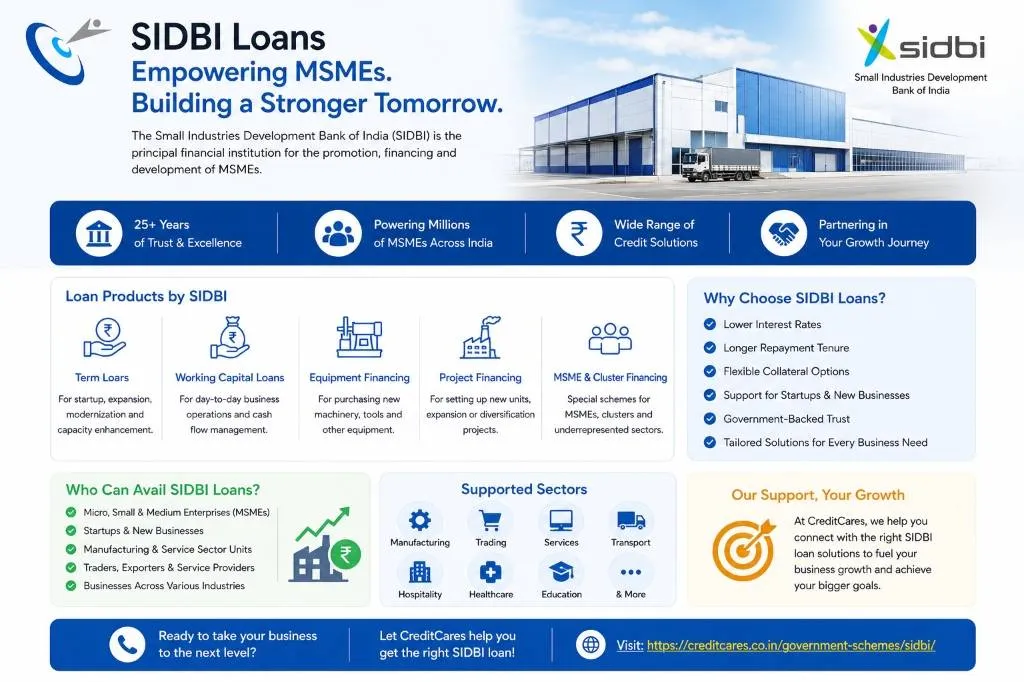
SIDBI has disbursed over ₹23,000 crore to support MSME growth, but the number of eligible businesses that actually reach sanction is a fraction of those who could qualify. This guide covers every major SIDBI loan scheme active in 2026 — SMILE, SPEED, SARE, SCECL, and indirect refinance options — with precise eligibility thresholds, the documents you actually need, and the application steps that move files forward instead of into a pending pile.
What is SIDBI and why does it matter for your business?
The Small Industries Development Bank of India (SIDBI) is a financial institution established to promote, finance, and develop the micro, small, and medium enterprise sector in India. It plays a central role in expanding access to institutional credit for MSMEs, particularly those that may find conventional bank financing challenging.
SIDBI operates through two primary channels. One is direct lending, where eligible MSMEs receive loans under specific schemes. The second is indirect or refinance support, where SIDBI provides funding support to banks and NBFCs, which then extend credit to MSMEs based on their own lending frameworks.
In plain terms:
SIDBI loans are government-backed, carry lower interest rates than most commercial banks, and come with longer repayment tenures — but they follow a structured process that rewards preparation. Businesses that arrive with the right documents and the right scheme selected move quickly. Those that don't often wait months without resolution.
MSME classification under revised 2025 criteria
Eligibility for SIDBI loan schemes in India generally depends on your MSME classification as per your Udyam Registration, based on the revised criteria effective from 1 April 2025:
- Micro enterprises: Investment up to ₹2.5 crore and turnover up to ₹10 crore
- Small enterprises: Investment up to ₹25 crore and turnover up to ₹100 crore
- Medium enterprises: Investment up to ₹125 crore and turnover up to ₹500 crore
Udyam Registration is mandatory before applying to any SIDBI scheme. Registration is free and takes approximately 15 minutes on the Udyam portal.
SIDBI direct loan schemes in 2026: the full breakdown
| Scheme | Best suited for | Loan amount | Key rate / tenure |
|---|---|---|---|
| SMILE | New & expanding MSMEs in 25 Make in India sectors | ₹10 lakh (soft loan) to ₹25 lakh (term loan) | 9.15%–9.35% (Yr 1–3), up to 10 years |
| SEF (SMILE Equipment Finance) | Equipment purchase, existing MSMEs ≥3 years | Up to ₹1 crore | Up to 72 months |
| SPEED | Faster equipment financing via digital process | Up to ₹1 crore | Up to 60 months |
| SPEED+ | High-growth MSMEs buying from MoU OEMs | Up to ₹2 crore (new), ₹3 crore (existing) | 8.80%–10.50%, 2–5 years |
| SARE | Businesses hit by external shocks | Concessional rates for restructuring | Scheme-specific |
| SCECL | Sectors needing emergency liquidity | Up to 20% of outstanding | 5%–6% (extended) |
| General Term Loan | Working capital and expansion | ₹10 lakh to ₹25 crore | SIDBI benchmark rate |
SMILE — SIDBI's flagship Make in India scheme
SMILE (SIDBI Make in India Soft Loan Fund) combines a term loan with a quasi-equity soft loan, carrying rates 2% below market and a 3-year moratorium. The SMILE scheme is designed to advance the Government of India's 'Make in India' initiative and encourage MSME participation. The focus is on twenty-five identified sectors, with an emphasis on financing smaller enterprises.
Key SMILE details for 2026:
- Repayment tenure up to 10 years, including a moratorium of up to 36 months.
- Minimum promoter contribution of 15%, with a maximum debt-to-equity ratio of 3:1.
- For SC/ST entrepreneurs, women promoters (minimum 51% controlling stake), and persons with disability: soft loan up to ₹30 lakh against a standard ₹20 lakh ceiling.
- Loan funds cannot be used to repay existing debt.
- Processing fee: 0.50% of loan amount upfront.
SPEED and SPEED+ — equipment financing with a faster path
The SIDBI SPEED scheme is a financing initiative launched to support MSMEs in acquiring modern machinery and equipment. The scheme aims to enhance productivity and technological capability by making equipment financing more accessible and affordable. It offers term loans specifically for purchasing approved equipment from designated original equipment manufacturers (OEMs), ensuring quality and reliability.
SPEED+ goes further: the eligibility criteria require that MSME units have at least five years of operations with stable sales and cash profits in the immediate past 3 years. Second-hand or refurbished machinery is not eligible under either variant.
SARE and SCECL — for businesses under stress or in recovery
SARE offers concessional loans for businesses hit by external shocks, enabling restructuring without negatively impacting credit scores. SCECL has been extended for critical sectors; eligible firms can still access up to 20% of outstanding loans at 5%–6% interest.
While the above schemes involve borrowing directly from SIDBI, many businesses may find it easier to access funds through their local banks.
SIDBI indirect financing: when you borrow through your bank
Indirect financing works differently. Financial institutions get funding from SIDBI and make loans to MSMEs, determined by their own evaluations. This increases the reach of SIDBI refinance in smaller communities and startup companies. A key part of this system is the CGTMSE credit guarantee, which allows eligible MSMEs to get loans without collateral in certain cases.
CGTMSE covers 75%–85% of the lender's loss if a borrower defaults. This gives banks the confidence to lend up to ₹5 crore without asking you to pledge property. The Annual Guarantee Fee is charged to the lending bank, not the borrower directly, though it may be passed on in the interest rate.
SIDBI loan eligibility: what you actually need to qualify
Common eligibility conditions across most SIDBI direct schemes:
- Business registration: Valid Udyam Registration Certificate.
- Business vintage: Minimum 3 years of operations for most schemes (2 years for existing SIDBI customers; 5 years for loans above ₹5 crore).
- Financial health: Profitable for at least 2 consecutive years, no defaults with any lender, and a satisfactory CIBIL or CMR rating.
- Credit score: Maintain a 700+ credit score, file GST/ITR on time, limit existing leverage to less than 2× net worth, and present a robust cash-flow projection that covers EMI 1.5×.
- Debt-to-equity ratio: Maximum 3:1 for most schemes.
- Special categories: Women, SC/ST entrepreneurs, and units in Northeastern states get softer terms.
For startups applying through PRAYAAS or startup lifecycle schemes, SIDBI evaluates innovation potential and management capability rather than purely financial history.
Documents required for a SIDBI loan application
Gather these before you approach SIDBI or a partner branch. Missing even one can delay processing by weeks.
Identity and address (KYC)
- PAN card of the business and promoters/directors
- Aadhaar card of promoters/directors
- Voter ID, passport, or driver's licence as supporting address proof
Business registration
- Udyam Registration Certificate (mandatory)
- GST registration certificate
- Certificate of incorporation or partnership deed
- Shop and establishment licence if applicable
Financial documents
- Audited financial statements for the past 2–3 years
- Income tax returns for the past 2–3 years
- Bank statements for the past 12 months
- CA-certified provisional balance sheet if applying between April and October
Loan-specific documents
- Detailed Project Report (DPR) covering investment plan, market feasibility, and repayment schedule
- Quotation or proforma invoice from supplier (for equipment loans)
- Statement of immovable properties of promoters/directors
- Cost-benefit analysis
Supporting (where applicable)
- Export contracts or purchase orders (strengthens working capital applications)
- CGTMSE guarantee application (for collateral-free loan route)
- MoU OEM quotation (for SPEED/SPEED+ scheme)
How to apply for a SIDBI loan: step by step
Register on Udyam Portal
Confirm your MSME classification and download your certificate.
Choose the right scheme
Match your purpose (equipment, expansion, working capital, stress relief) to the table above.
Prepare your DPR
This is the most scrutinised document; banks reject applications where the DPR uses template figures rather than business-specific projections.
Visit udyamimitra.in or sidbi.in
Use the online application portal to select your scheme, fill in the form, and upload documents with an e-signature.
Choose the right branch
For larger loans, visit a SIDBI branch directly; for CGTMSE-backed loans, approach a bank's dedicated MSME window, not a general retail branch.
Respond promptly to queries
Credit appraisal may involve a site visit or video verification; delays on your side pause the clock on the lender's side.
Receive sanction and sign
Once approved, sign the loan agreement; funds are credited to your current account.
Under priority sector lending norms, banks are required to issue a sanction letter within 15 to 30 working days of a complete application. If your file sits beyond 30 working days without a decision, escalate in writing to the branch manager or the bank's MSME help desk.
Insider insight: why good applications still get rejected
CGTMSE-backed applications are delayed or rejected because of poor project documentation instead of credit quality issues, as per data collated by SIDBI and various MSME advisory bodies. This includes a lack of a detailed project report (DPR), a poor market feasibility analysis, or a lack of validation regarding promoter expertise in the sector.
Here are three things most guides won't tell you:
1. Your personal CIBIL score matters as much as your business score.
Even if business income is strong, poor personal credit can cause rejection because most MSME loans are linked to the proprietor's profile. Check and clean your personal CIBIL report before applying — not after.
2. Branch selection changes your outcome.
Entrepreneurs must be proactive and reach out to banks in a specific MSME branch or a window organised by SIDBI instead of retail branches staffed by generalists. MSME-oriented branches have relationship managers who are far more capable of processing CGTMSE applications.
3. Scheme stacking multiplies your benefit.
Single-scheme thinking limits your potential; stacking multiple schemes (such as a subsidy, a guarantee, and a procurement preference) can cut the financial burden on the promoter in half. For example, a manufacturing unit upgrading to CNC machinery can combine a CGTMSE-guaranteed bank loan (collateral-free), a CLCSS technology upgradation subsidy (reducing machinery cost), and GeM registration (creating a guaranteed demand channel) — each application is separate, but together they dramatically reduce out-of-pocket cost and repayment pressure.
SIDBI loan interest rates in 2026
Interest rates can range from 8%–12% per annum, depending on various factors. Specific benchmarks:
- SMILE soft loan (years 1–3): 9.15%–9.35% p.a.
- SMILE term loan (years 1–3): 9.45%–9.95% p.a.; from year 4: 11.70%–12.70% (floating or fixed)
- SPEED+: 8.80%–10.50% p.a.
- Equipment loans via SIDBI partnerships (JICA/World Bank linked): 9.25%–10% for qualifying units
- SCECL extended scheme: 5%–6% p.a. for critical sectors
Note: No prepayment penalty applies on floating-rate SIDBI loans — borrowers can repay early without additional charges.
SIDBI vs bank vs NBFC: which route for your situation?
| Factor | SIDBI direct | Bank (CGTMSE-backed) | NBFC |
|---|---|---|---|
| Interest rate | Lowest (often 1–2% below bank MCLR) | Moderate (market rate) | Highest |
| Collateral | Flexible; some schemes collateral-free | Collateral-free up to ₹5 crore with CGTMSE | Often unsecured but at higher cost |
| Processing speed | Moderate | Moderate (15–30 working days post-complete file) | Fastest |
| Loan tenure | Longest (up to 10 years) | Standard | Shorter |
| Best for | Long-term investment, machinery, expansion | First-time borrowers, collateral-free need | Urgent working capital when speed matters |
For most MSMEs with a 3+ year track record and clean credit, a SIDBI direct loan or a CGTMSE-backed bank loan is the right primary route. Combine SIDBI's long-term loan with a bank overdraft for balanced liquidity.
Government programmes linked to SIDBI in 2026
SIDBI is the implementing partner or nodal agency for several wider government programmes:
- PM Vishwakarma: Credit support for traditional artisans; enterprise development loans up to ₹3 lakh at 5% (fixed), with 8% interest subvention from the government paid upfront.
- PM SVANidhi: Working capital for street vendors through SIDBI-linked bank channels.
- PSB Loans in 59 Minutes: Digital portal integrating GST and income-tax data for faster in-principle approvals; over 5.55 lakh applications approved to date.
- PRAYAAS: Micro-entrepreneur support, including women-led businesses, through SIDBI partner institutions.
- Animal Husbandry Infrastructure Development Fund (AHIDF): SIDBI manages the end-to-end digital application for dairy, meat processing, and animal feed plant financing.