
PM Mudra Yojana 2026: Loan Limit, Eligibility & How to Apply Online
PM Mudra Yojana has disbursed over 57.79 crore loans worth ₹40.07 lakh crore since its April 2015 launch — yet thousands of applicants walk into a bank branch every month and walk out with a rejection slip they didn't expect. Most guides tell you the scheme is collateral-free and leave it at that. This one won't. Below is everything you need to know about PM Mudra Yojana in 2026 — the updated ₹20 lakh Tarun Plus category, the documents that actually get approved, and the reason loan officers still say no even when you technically qualify.
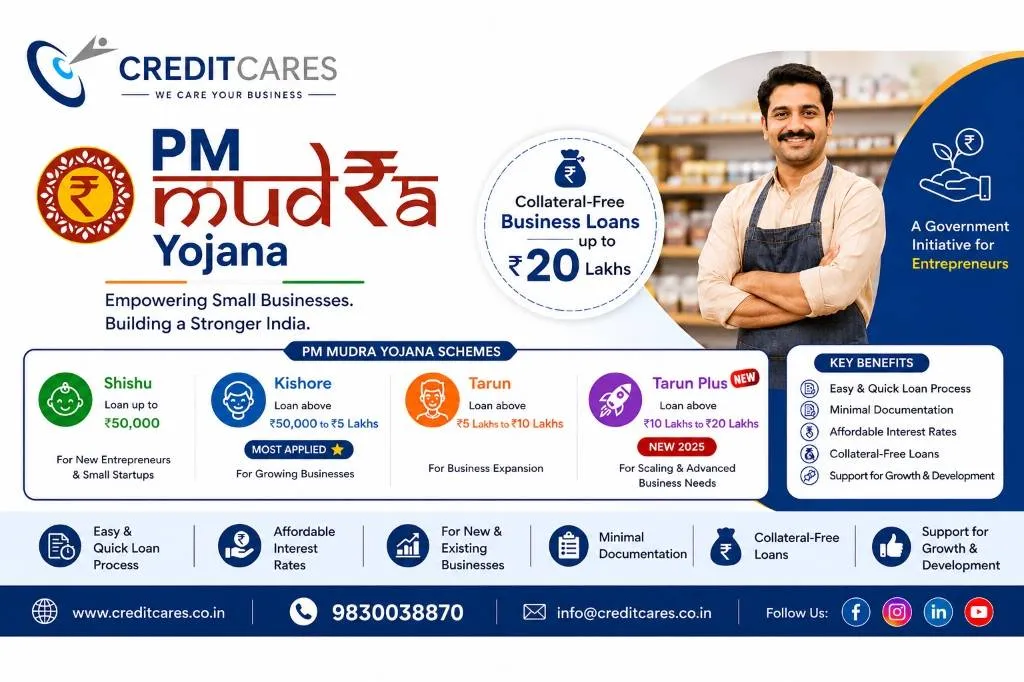
PM Mudra Yojana (PMMY) is a Government of India scheme that provides collateral-free business loans up to ₹20 lakh to non-farm, non-corporate micro and small enterprises through banks, NBFCs, and MFIs. Launched on 8 April 2015, the scheme is structured into four categories — Shishu, Kishore, Tarun, and the new Tarun Plus — matching the loan amount to the stage of business growth.
Whether you are a street vendor in Howrah looking for ₹30,000 to buy a new cart, a garment trader in Kolkata's Burrabazar needing ₹4 lakh for stock, or a food processing unit in Durgapur ready to scale with ₹8 lakh of equipment finance — there is a Mudra category built for your stage. This guide covers all four loan tiers, the exact eligibility rules, a category-wise document checklist, bank-wise interest rates, and a step-by-step application walkthrough for 2026.
Mudra is a government-backed refinance scheme — not a direct lending window. MUDRA Ltd. provides funds to banks and MFIs, which then lend to you. This means the interest rate, turnaround time, and credit assessment standards all depend on the individual bank you approach — not on a single government rate sheet. Applying to a public sector bank (SBI, Bank of Baroda) typically means stricter documentation but lower rates; an MFI or NBFC is faster but may cost 2–4% more per year.
What are the four PM Mudra Yojana categories?
The scheme is structured into four tiers that map to different stages of a business lifecycle. Each category differs in loan amount, eligibility conditions, and the depth of documentation a lender will typically require.
| Category | Loan Range | Best For | Who Can Apply | Credit Guarantee |
|---|---|---|---|---|
| Shishu | Up to ₹50,000 | First-time entrepreneurs, street vendors, artisans | Any eligible non-farm micro unit | CGTMSE / CGFMU |
| Kishore (Most applied) | ₹50,001 – ₹5 lakh | Businesses past the startup stage needing expansion capital | Any eligible non-farm micro unit | CGTMSE / CGFMU |
| Tarun | ₹5 lakh – ₹10 lakh | Established businesses scaling operations significantly | Any eligible non-farm micro unit | CGTMSE / CGFMU |
| Tarun Plus (New 2025) | ₹10 lakh – ₹20 lakh | High-growth enterprises that have graduated past Tarun | Only for borrowers who repaid a Tarun loan | CGFMU |
The Tarun Plus expansion — what changed and why it matters
Finance Minister Nirmala Sitharaman announced the Tarun Plus category in Union Budget 2024-25. It became fully operational across lenders through 2025-26. The intent is clear: rewarding repayment discipline. If you successfully closed a Tarun loan, you are no longer treated as a new borrower — you can access up to ₹20 lakh under CGFMU guarantee without pledging collateral, with repayment terms extending up to 7 years depending on the lender.
One important note: many guides still list ₹10 lakh as the PMMY maximum. That figure was correct before Budget 2024-25. The current ceiling is ₹20 lakh (Tarun Plus only). For all other first-time applicants, ₹10 lakh under Tarun remains the upper limit.
Who is eligible for a PM Mudra Yojana loan?
Eligibility for PMMY is deliberately broad — the scheme is designed to reach the widest possible base of small business owners who have historically been shut out of formal credit. The core criteria are:
- Indian citizen aged 18–65 years
- Running or starting a non-farm, non-corporate small business (manufacturing, trading, or services)
- Business purpose: income-generating activities only — not personal consumption or farm income
- Credit requirement below ₹20 lakh (or ₹10 lakh for first-time Tarun applicants)
- No existing loan default with any bank or financial institution
Businesses that qualify include: shops and kirana stores, food processing units, garment / textile units, beauty parlours, repair workshops, transport operators (auto-rickshaws, small trucks), dairy and poultry (allied agricultural activities only — not direct farming), and service-sector micro enterprises.
Businesses that do not qualify:
- Direct agricultural operations (crop loans, irrigation, land development)
- Corporate entities (Pvt Ltd, LLP, Public Ltd)
- Businesses requiring credit above ₹20 lakh
- Applicants with active loan defaults
A small ready-made garment trader operating from Burrabazar, Kolkata, has been sourcing stock from Surat on credit for two years. She wants to shift to direct purchases — buying ₹3.5 lakh of inventory upfront to access a 12% cash discount from the Surat supplier. Her CIBIL score is 680, she holds Udyam registration, and her last 12 months' bank statements show regular turnover. She applies under the Kishore category (₹3.5 lakh) at her existing bank branch. Because the loan amount is under ₹5 lakh and she has a clean credit history, her bank completes the assessment in 14 working days — the cash discount on direct purchasing effectively covers the first year's interest cost.
What documents do you need for a PM Mudra loan?
No collateral means no property documents — but you still need to prove identity, address, business existence, and repayment capacity. The document burden scales with the loan amount.
| Document Type | Shishu (up to ₹50k) | Kishore (up to ₹5L) | Tarun / Tarun Plus (up to ₹20L) |
|---|---|---|---|
| Identity proof (Aadhaar / PAN / Voter ID) | ✓ Required | ✓ Required | ✓ Required |
| Address proof (Aadhaar / utility bill) | ✓ Required | ✓ Required | ✓ Required |
| Passport-size photographs (2) | ✓ Required | ✓ Required | ✓ Required |
| Business proof (Udyam / shop licence / FSSAI etc.) | Recommended | ✓ Required | ✓ Required |
| Last 6–12 months bank statement | Recommended | ✓ Required | ✓ Required |
| Income Tax Returns / ITR | Not usually required | Recommended | ✓ Usually mandatory |
| Business plan / project report | Simple declaration | 2–3 page plan | Detailed project report |
| Udyam registration certificate | Strongly recommended | ✓ Required | ✓ Required |
| Previous Tarun loan closure proof | Not applicable | Not applicable | Mandatory for Tarun Plus only |
Free shortcut: Udyam Registration is completely free, done in minutes at udyamregistration.gov.in using only your Aadhaar. It is the single fastest way to establish business legitimacy before a Mudra application — and is now a near-universal requirement for Kishore and Tarun loans.
How to apply for PM Mudra Yojana in 2026
There are two valid application routes — online (faster for larger amounts once you know your lender) and offline (often simpler for Shishu loans and first-time borrowers).
-
1
Identify your category
Based on the amount you need, confirm which category applies — Shishu, Kishore, Tarun, or Tarun Plus. Applying in the wrong category (e.g., applying for Tarun Plus without a prior repaid Tarun loan) is an instant rejection.
-
2
Prepare your documents
Gather KYC proofs, business registration, bank statements, and — for Kishore and above — your business plan or project report. District Industries Centre (DIC) offices offer free templates. You can also download sample project reports from kviconline.gov.in.
-
3
Apply online via Udyami Mitra or Jan Samarth
Visit udyamimitra.in or the Jan Samarth portal (jansamarth.in). Fill in your business details, loan purpose, and amount. Upload scanned documents. The portal shows you a list of eligible lenders with their indicative rates — compare before selecting.
-
4
Receive an application number and in-principle approval
After submission, you receive an application number. For Shishu loans, some banks give in-principle approval digitally within 7–10 working days. Kishore loans typically take 2–3 weeks; Tarun and Tarun Plus, 3–4 weeks.
-
5
Visit the bank branch for final verification
After digital approval, carry original documents to your selected bank branch. The loan is disbursed to your account after final verification. A MUDRA Card (RuPay debit card linked to a working capital sub-limit) is issued alongside the loan — it lets you draw only what you need rather than the full amount at once.
-
6
Alternative: Walk into any PMMY-participating branch directly
For Shishu loans or if you prefer offline, walk into the nearest public sector bank, RRB, NBFC, or MFI branch. Ask for the PMMY application form for your category. This route often moves faster for very small loan amounts in Tier-3 districts.
Interest rates and repayment terms — what lenders actually offer
PMMY does not set a fixed interest rate. The Government of India guidelines only specify that rates must be "competitive" and in line with each lender's MCLR (Marginal Cost of Funds Based Lending Rate) plus a spread. Here is the typical range across major lenders as of mid-2026:
| Lender Type / Examples | Approx. Interest Rate (p.a.) | Processing Fee | Max Repayment Tenure |
|---|---|---|---|
| Public sector banks (SBI, Bank of Baroda, PNB, UCO) | 8.85% – 10.5% | Nil (Shishu); ~0.5% (Kishore/Tarun) | 5–7 years |
| Private sector banks (HDFC, ICICI, Axis) | 10% – 12% | ~0.5% – 1% | 3–5 years |
| Regional Rural Banks (RRBs) | 9% – 11.5% | Nil to minimal | 5 years |
| NBFCs and MFIs | 11% – 13% | 1% – 2% | 1–3 years |
There are no foreclosure charges on Mudra loans — you can prepay without penalty at any point. Processing fees for Shishu loans are nil across most public sector lenders. A CIBIL score above 700 typically unlocks the lower end of the rate band at any institution.
The single biggest misconception about PMMY is that a government scheme with no collateral requirement is close to automatic. It isn't. Banks cover their credit risk through CGFMU — but they still approve loans only to borrowers they believe will repay. Since there's no property to fall back on, your business plan and credit history become the only security the lender has.
Here is what loan officers cite as the actual drivers of Mudra rejections:
- CIBIL score below 650: Officially, no minimum score is mandated by PMMY guidelines. Practically, most banks filter below 650 — even a single unpaid mobile EMI or credit card late payment can push a score to this zone. Check your CIBIL before you apply.
- A vague or generic business plan: "I want to start a shop" doesn't answer the questions a credit officer needs — what will you sell, to whom, at what margin, and how will the EMI be covered from month-to-month cash flow? A 2–3 page plan with specific numbers passes; a one-line purpose statement often doesn't.
- Mismatched documents: An Aadhaar with one address and a bank account at another address — both technically yours — creates a verification mismatch that many bank systems flag automatically. Standardize your address across KYC documents before applying.
- Applying for more than your business can justify: A vegetable vendor with ₹15,000 monthly turnover applying for ₹4 lakh (Kishore) will be asked how the EMI fits into ₹15,000 of revenue. The amount must match demonstrable cash flow — not aspiration.
- Applying to multiple banks simultaneously: Each application triggers a hard enquiry on your CIBIL report. Multiple simultaneous hard enquiries signal financial stress to lenders and lower your score — creating a cycle. Apply to one lender at a time.
The fix is preparation, not persistence. Address the issue before reapplying — resubmitting the same documents to the same bank immediately after rejection will not produce a different outcome.
PM Mudra Yojana vs regular MSME business loan — which should you choose?
PMMY is not the only route to formal credit. Here is a quick comparison to help you decide whether a Mudra loan or a standard MSME loan is the better fit:
| Factor | PM Mudra Yojana (PMMY) | Regular MSME / Business Loan |
|---|---|---|
| Maximum loan amount | ₹20 lakh (Tarun Plus) | ₹1 crore and above (varies by product) |
| Collateral | None required (CGFMU backed) | Often required above ₹10 lakh; CGTMSE for some |
| Business vintage requirement | None for Shishu; informal for Kishore/Tarun | Typically 2–3 years with ITR / audited accounts |
| Processing time | 7 days (Shishu) to 4 weeks (Tarun) | 2–6 weeks (varies by lender and documentation) |
| Interest rate range | 8.85% – 13% p.a. | 9% – 18% p.a. (depends on credit profile, product type) |
| Eligible borrowers | Non-farm micro and small enterprises only | MSMEs across all sectors including larger units |
If your credit requirement is below ₹20 lakh and your business qualifies as a non-farm micro enterprise, PMMY is almost always the right first stop — the collateral-free structure and government backing make it accessible to a much wider borrower pool than standard MSME lending. Once your business outgrows ₹20 lakh, or once you need a structured term loan, cash credit facility, or project finance, formal MSME banking channels are the natural next step.
Frequently asked questions about PM Mudra Yojana
Disclaimer: This article is for informational purposes only and does not constitute financial, legal, or investment advice. PM Mudra Yojana eligibility, interest rates, and loan limits are determined by the Government of India and individual lending institutions, and may be revised. Always verify current scheme guidelines at mudra.org.in and udyamimitra.in before making a financial decision. Loan approval is at the sole discretion of the lending institution.