
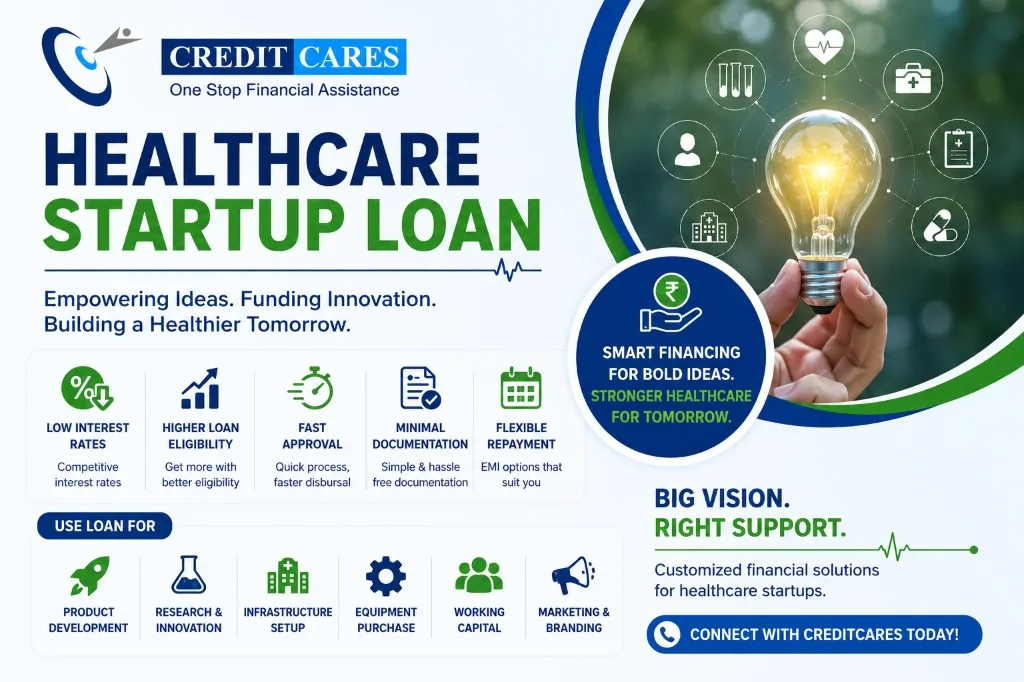
Healthcare startups default to thinking equity — but debt, used well, is how founders fund growth without surrendering ownership. A telemedicine platform with subscription revenue, a diagnostic-tech startup with hospital contracts, a digital pharmacy with transaction volume: each has cash flows that lenders can underwrite, and a widening menu of products built to do it.
The routes, roughly by stage: government scheme lending — Startup India-linked benefits, CGTMSE-covered facilities for Udyam-registered units, and SIDBI's startup programs — for early, pre-profit companies with registrations in order; working-capital and invoice-financing lines once B2B contracts and receivables exist; equipment and machinery finance for device and lab-based startups; and venture debt (typically alongside or after an equity round) for VC-backed companies wanting runway extension without another dilution event.
Regulated-sector credibility does double duty here: CDSCO registrations, clinical validations and hospital partnerships that win customers also win credit committees. CreditCares maps the route that fits your stage and revenue shape, prepares the file to institutional standard, and places it across our panel's startup-active lenders — while being honest when a profile is genuinely too early for debt and equity is the right answer.
Startup profiles and their debt routes
Telemedicine & digital health
Subscription/consultation revenue underwritten for working-capital and revenue-based lines.
Digital pharmacies
Inventory and receivable finance layered on drug-license-compliant operations.
Device startups
Machinery finance and CGTMSE-covered term loans for pilot and scale production.
Biotech & diagnostics tech
Equipment finance for labs; scheme funding for validated, licensed operations.
HealthTech SaaS
Contracted ARR financing and invoice discounting against hospital-chain receivables.
VC-backed companies
Venture debt of 15–25% of the last equity round for runway extension.
Interest rates & terms (2026, indicative)
| Route | Pricing | Fit |
|---|---|---|
| Scheme & CGTMSE routes | 10.00% – 13.00% p.a. | Early-stage, registration-driven |
| Working capital / invoice finance | 11.00% – 14.00% p.a. | Revenue & receivable-based |
| Venture debt | 13.00% – 16.00% + warrants | Post-equity-round companies |
Rates are indicative market ranges for mid-2026 and vary by lender policy, credit profile and security. Final pricing rests with the sanctioning bank/NBFC.
Eligibility (typical)
- Incorporated entity (Pvt Ltd/LLP), ideally DPIIT-recognised startup
- Udyam registration for CGTMSE/MSME routes
- Sector compliances: CDSCO, drug license, telemedicine-practice guidelines as applicable
- Demonstrable revenue, contracts or (for venture debt) institutional equity backing
- Founders with acceptable bureau records
- 12+ months' operating history for most debt routes
Documents required
- Incorporation papers; DPIIT recognition if held
- Udyam registration; sector licenses/registrations
- MIS: revenue, contracts, pipeline; pitch/business plan
- ITRs & financials (as available); GST returns
- 12 months' banking
- Cap table & funding history (for venture-debt routes)
Startup Loan EMI Calculator
Indicative only — final rate and eligibility are decided by the lender based on your profile and security.
How CreditCares gets you sanctioned faster
Profile & lender match
We map your financials and security to the lenders — from our 80+ bank & NBFC panel — most likely to approve on the best terms.
Bank-ready file
Financials, projections, property/KYC papers structured exactly the way credit teams want to see them.
Negotiation & follow-up
We place the file with multiple lenders, negotiate rate, LTV and fees, and keep approvals moving.
Sanction & disbursal
Terms finalised, sanction issued, funds disbursed — tracked end to end by one team.
Frequently asked questions
Can a pre-revenue healthcare startup get a loan at all?
Rarely through commercial debt — lenders need cash flows or a guarantee framework. Pre-revenue options are scheme-based: CGTMSE-covered facilities for registered units with viable plans, SIDBI startup programs, and state startup schemes. Otherwise, the honest answer is that equity or grants come first and debt follows revenue — and we'll say so rather than shop a doomed file.
What is venture debt and when does it make sense?
Term debt (often with small equity warrants) extended to VC-backed startups, typically 15–25% of the last round's size, at 13–16%. It buys 6–12 months of extra runway or funds working capital without pricing a new equity round. It fits post-Series-A healthcare companies with visible revenue; it's dangerous for companies burning cash with no path to the next milestone.
We're a telemedicine platform — what do lenders actually underwrite?
Recurring revenue quality: subscription and consultation volumes, retention, payor mix (B2C versus B2B hospital/corporate contracts), and compliance with telemedicine practice guidelines. B2B contracts with hospitals and insurers are especially bankable — they convert into invoice-financing lines almost mechanically.
Does DPIIT startup recognition actually help with loans?
It helps at the margins that matter: eligibility for startup-specific schemes and funds, easier access to certain public-sector programs, and signalling in credit appraisal. It doesn't replace revenue or licenses — think of it as a multiplier on an otherwise fundable file.
Debt or equity for our device startup's first production line?
If you have orders or LOIs, machinery finance funding 75–90% of the line is usually smarter than selling equity to buy equipment — the asset secures itself and dilution is saved for R&D and market-building that debt can't fund. We model the blend; the right answer is almost always a mix, sequenced deliberately.
Related loan products
MSME Loan for Pharma
View →Medical Device Manufacturing Loan
View →Healthcare Working Capital
View →Pharma & Healthcare Loans — hub
View →Get the right lender, not just any lender
Share a few details and a CreditCares expert will map your eligibility across 80+ banks & NBFCs — free, confidential, no obligation. Since 2012 · ₹2,000 Cr+ facilitated · 4.9★ on Google.
Get my free eligibility check Call +91 98300 38870Disclaimer: CreditCares is a private loan consultancy / DSA — not a bank, NBFC or government body. Interest rates, LTV and eligibility parameters shown are indicative market ranges for 2026 and change with lender policy. Loan approval, pricing and terms rest solely with the sanctioning bank/NBFC. Tax notes are general summaries — consult a Chartered Accountant before claiming deductions.