
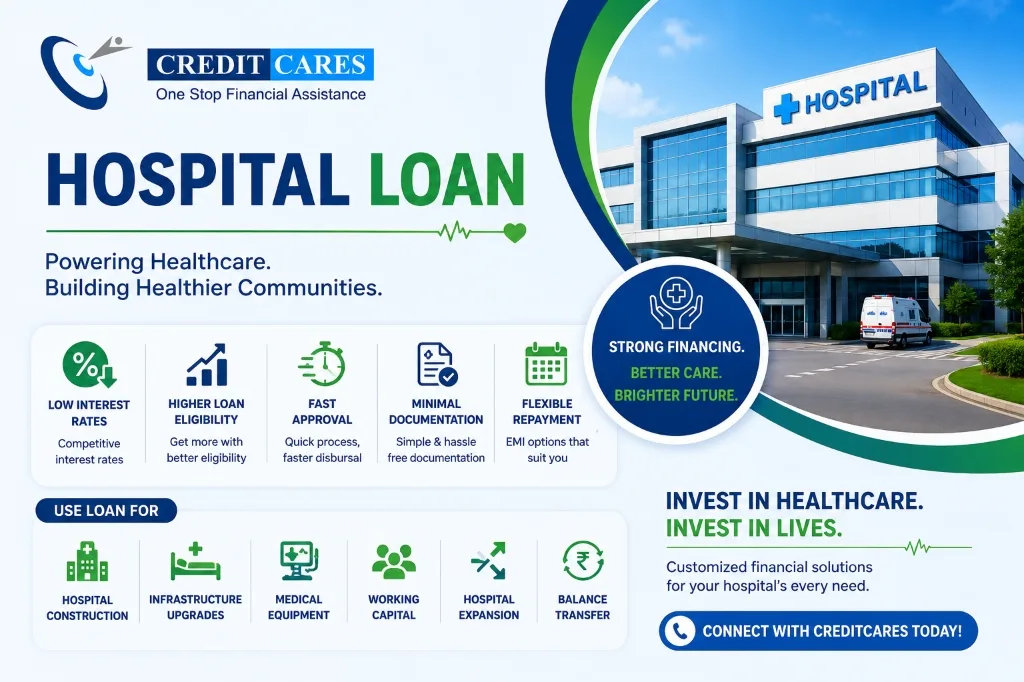
Hospitals are capital beasts: a single modular OT costs ₹1–2 Crore, an ICU bed ₹15–25 Lakh fully equipped, and a new wing runs into tens of crores before the first patient is admitted. Hospital loans are structured for exactly this — term and project finance where disbursement follows the build, principal waits out a moratorium of up to 24 months, and repayment maps to occupancy ramp-up rather than a flat EMI from day one.
Lenders underwrite hospitals on operating fundamentals: bed count and occupancy, payor mix (cash, insurance, Swasthya Sathi/CGHS/ECHS empanelments), specialty economics and the promoters' clinical track record. Existing facilities with 2–3 years of operations borrow readily for expansion; greenfield projects need stronger promoter equity and a credible commissioning plan — and both benefit enormously from a file that speaks the credit team's language.
CreditCares packages hospital projects end to end — cost sheets, approval matrices (clinical establishment license, fire NOC, biomedical waste authorisation, AERB where imaging is involved), cash-flow models and phased disbursement schedules — then places them with the banks and NBFCs on our panel that actively book hospital risk at your ticket size.
What hospital finance covers
New construction
Ground-up hospital and nursing-home buildings with stage-wise disbursal.
Floor & wing expansion
Adding beds, floors or a specialty block to a running facility.
ICU & critical care
Ventilators, monitors, central gas lines and full ICU commissioning.
Operation theatres
Modular OTs, laminar flow, anaesthesia workstations and surgical equipment.
Modernisation
NABH-readiness upgrades, fire-safety retrofits, HVAC and digital systems.
Working capital
Consumables, salaries and insurer/TPA receivable cycles alongside the term loan.
Interest rates & terms (2026, indicative)
| Lender type | Interest rate | Typical LTV / funding |
|---|---|---|
| Public sector banks | 9.50% – 11.00% p.a. | Project finance, keenest pricing |
| Private banks | 10.00% – 12.00% p.a. | Faster processing, composite limits |
| NBFC healthcare programs | 11.00% – 12.50%+ p.a. | Higher leverage, flexible structures |
Rates are indicative market ranges for mid-2026 and vary by lender policy, credit profile and security. Final pricing rests with the sanctioning bank/NBFC.
Eligibility (typical)
- Registered clinical establishment (or credible greenfield plan) with required licenses
- Promoters with clinical/operational track record; 2–3 years' operations for expansion loans
- Promoter margin typically 25–35% of project cost
- Viable DSCR on projected cash flows; empanelments strengthen the file
- Land/building ownership or long lease for construction projects
- Acceptable bureau record of entity and promoters
Documents required
- Clinical establishment registration, fire NOC, biomedical waste authorisation
- Project report: cost sheet, bed plan, equipment list, revenue model
- Property papers / lease deed; sanctioned building plan for construction
- 3 years' financials & ITRs of entity and promoters
- 12 months' banking; existing loan sanction letters
- Empanelment letters (insurance/TPA/government schemes) if held
Hospital Loan EMI Calculator
Indicative only — final rate and eligibility are decided by the lender based on your profile and security.
How CreditCares gets you sanctioned faster
Profile & lender match
We map your financials and security to the lenders — from our 80+ bank & NBFC panel — most likely to approve on the best terms.
Bank-ready file
Financials, projections, property/KYC papers structured exactly the way credit teams want to see them.
Negotiation & follow-up
We place the file with multiple lenders, negotiate rate, LTV and fees, and keep approvals moving.
Sanction & disbursal
Terms finalised, sanction issued, funds disbursed — tracked end to end by one team.
Frequently asked questions
Can a running nursing home get a loan to add a floor?
Yes — expansion of an operating facility is the most fundable hospital deal there is. Two to three years of financials, current licenses and a costed expansion plan typically secure 65–75% of project cost with a construction-period moratorium.
How do lenders treat Swasthya Sathi and insurance receivables?
Empanelments cut both ways: they prove demand and documentable revenue (good for the term-loan case) but stretch receivable cycles (which argues for a working-capital limit alongside). We structure composite facilities that fund the build and the receivable float together.
Is greenfield hospital finance realistic for a first-time promoter?
It's harder but done regularly — the file needs practising-doctor promoters or hired clinical leadership, 30%+ equity, a defensible catchment analysis and a commissioning timeline. NBFC healthcare desks are often the entry point, refinanced to bank pricing once operations stabilise.
What moratorium can we get during construction?
Typically 12–24 months' principal moratorium covering the build plus early ramp-up, with interest serviced on disbursed amounts. Repayment then steps up with projected occupancy rather than starting at full EMI.
Can equipment be bundled into the hospital project loan?
Yes — OT, ICU and imaging equipment are standard line items in the project cost, funded within the same facility or as a parallel equipment tranche at equipment-finance pricing, whichever nets cheaper. One blended sanction beats three separate applications.
Related loan products
Medical Equipment Loan
View →Healthcare Infrastructure Loan
View →Healthcare Working Capital
View →Pharma & Healthcare Loans — hub
View →Get the right lender, not just any lender
Share a few details and a CreditCares expert will map your eligibility across 80+ banks & NBFCs — free, confidential, no obligation. Since 2012 · ₹2,000 Cr+ facilitated · 4.9★ on Google.
Get my free eligibility check Call +91 98300 38870Disclaimer: CreditCares is a private loan consultancy / DSA — not a bank, NBFC or government body. Interest rates, LTV and eligibility parameters shown are indicative market ranges for 2026 and change with lender policy. Loan approval, pricing and terms rest solely with the sanctioning bank/NBFC. Tax notes are general summaries — consult a Chartered Accountant before claiming deductions.