
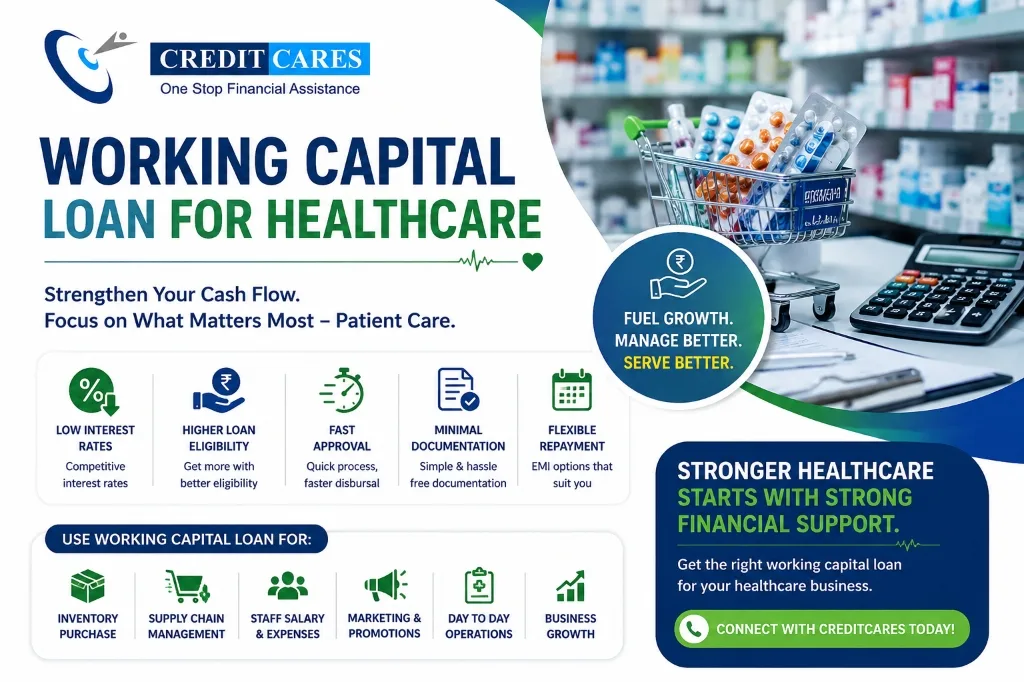
Healthcare businesses earn steadily but collect slowly. Hospitals wait 30–90 days on insurers, TPAs and government schemes; pharma companies and equipment suppliers extend 60–120 day credit to institutions; pharmacies and distributors carry inventory the market demands before it pays. Working capital finance exists to carry that float so operations never do.
The instruments: cash credit (CC) limits against inventory and book debts — you draw as needed, pay interest only on utilisation; overdrafts against financials or collateral; invoice discounting that converts insurer/TPA/institutional receivables into immediate cash; and short-term loans for defined bulges like annual consumable purchases or scheme-payment delays. Healthcare's documentable receivables (claim records, empanelment contracts, tender POs) make its limits easier to justify than most industries' — when the file presents them properly.
CreditCares sizes the limit from your actual operating cycle — not a thumb rule — then places it where pricing and drawing-power rules fit your mix of payors and stock. Renewals, enhancements and stuck-limit rescues are daily work for us.
What healthcare working capital covers
Salaries & staffing
Payroll continuity for clinical and support teams through collection troughs.
Vendor & consumable payments
Pharma supplies, surgical consumables, reagents and implants on time — protecting supplier pricing.
Insurer/TPA receivable float
Cash against claims pending with insurers, TPAs and government schemes.
Inventory cycles
Medicine, device and reagent stock ahead of demand and tenders.
Seasonal & tender bulges
Short-term lines for institutional supply orders and seasonal surges.
Equipment-supplier cycles
Financing the gap between OEM payment terms and hospital collection cycles.
Interest rates & terms (2026, indicative)
| Lender type | Interest rate | Typical LTV / funding |
|---|---|---|
| Bank CC/OD limits | 9.50% – 12.00% p.a. | Interest on utilisation only |
| Invoice/receivable financing | 10.50% – 13.50% p.a. | 75–90% of eligible invoices |
| NBFC short-term lines | 12.00% – 14.00% p.a. | Fast, banking-surrogate based |
Rates are indicative market ranges for mid-2026 and vary by lender policy, credit profile and security. Final pricing rests with the sanctioning bank/NBFC.
Eligibility (typical)
- Operating healthcare business with 2–3 years' vintage
- GST/receipts and banking supporting declared revenue
- Receivables from identifiable payors (insurers, TPAs, institutions)
- Stock and debtors available for hypothecation (CC limits)
- Acceptable bureau record; no recent bounces
- Existing limits (if any) conducted within drawing power
Documents required
- 2–3 years' ITRs & financials; GST returns
- 12 months' banking (all operating accounts)
- Debtor ageing & stock statement
- Empanelment/contract letters (insurers, TPAs, schemes, institutions)
- KYC & licenses of the establishment
- Existing sanction letters & conduct reports
Working Capital EMI Calculator
Indicative only — final rate and eligibility are decided by the lender based on your profile and security.
How CreditCares gets you sanctioned faster
Profile & lender match
We map your financials and security to the lenders — from our 80+ bank & NBFC panel — most likely to approve on the best terms.
Bank-ready file
Financials, projections, property/KYC papers structured exactly the way credit teams want to see them.
Negotiation & follow-up
We place the file with multiple lenders, negotiate rate, LTV and fees, and keep approvals moving.
Sanction & disbursal
Terms finalised, sanction issued, funds disbursed — tracked end to end by one team.
Frequently asked questions
CC limit or term loan — which does my hospital need?
If the need repeats with your operating cycle (receivables, consumables, payroll float), a CC/OD limit — you pay interest only on what you draw. If it's a one-time asset (equipment, renovation), a term loan. Most healthcare businesses genuinely need both, sanctioned as one composite facility.
Can pending insurance and TPA claims really be financed?
Yes — documented claims receivable from insurers, TPAs and government schemes are financeable through invoice/receivable discounting at 75–90% of eligible value. Clean claim records and empanelment contracts are the underwriting backbone, and hospitals with organised billing get the best advance rates.
How is my drawing power calculated on a CC limit?
Monthly: (eligible stock × margin, typically 25%) + (eligible debtors within the cover period, usually 90 days, × margin) − creditors. You can draw up to that number within your sanctioned limit. We coach clients on statement hygiene so drawing power stays maximised.
Government scheme payments are delayed — can working capital bridge months of dues?
That's one of its core jobs. Scheme receivables (e.g., state health schemes, CGHS/ECHS) are slow but sovereign-adjacent — lenders finance them with longer cover periods. A hospital heavy on scheme patients should size its limit explicitly around that cycle, not around cash-patient assumptions.
What does an unused limit cost?
Banks may levy a small commitment charge on substantially unutilised limits, but the real cost of an undersized limit — emergency borrowing at 18%+ or supplier default — is far worse. We size limits to your P90 requirement, not your average month.
Related loan products
Pharma Distributor Loan
View →Hospital Loan
View →Working Capital · CC & OD — all sectors
View →Pharma & Healthcare Loans — hub
View →Get the right lender, not just any lender
Share a few details and a CreditCares expert will map your eligibility across 80+ banks & NBFCs — free, confidential, no obligation. Since 2012 · ₹2,000 Cr+ facilitated · 4.9★ on Google.
Get my free eligibility check Call +91 98300 38870Disclaimer: CreditCares is a private loan consultancy / DSA — not a bank, NBFC or government body. Interest rates, LTV and eligibility parameters shown are indicative market ranges for 2026 and change with lender policy. Loan approval, pricing and terms rest solely with the sanctioning bank/NBFC. Tax notes are general summaries — consult a Chartered Accountant before claiming deductions.