
Startup India Seed Fund Scheme (SISFS): Eligibility, Amount & How to Apply (2026)
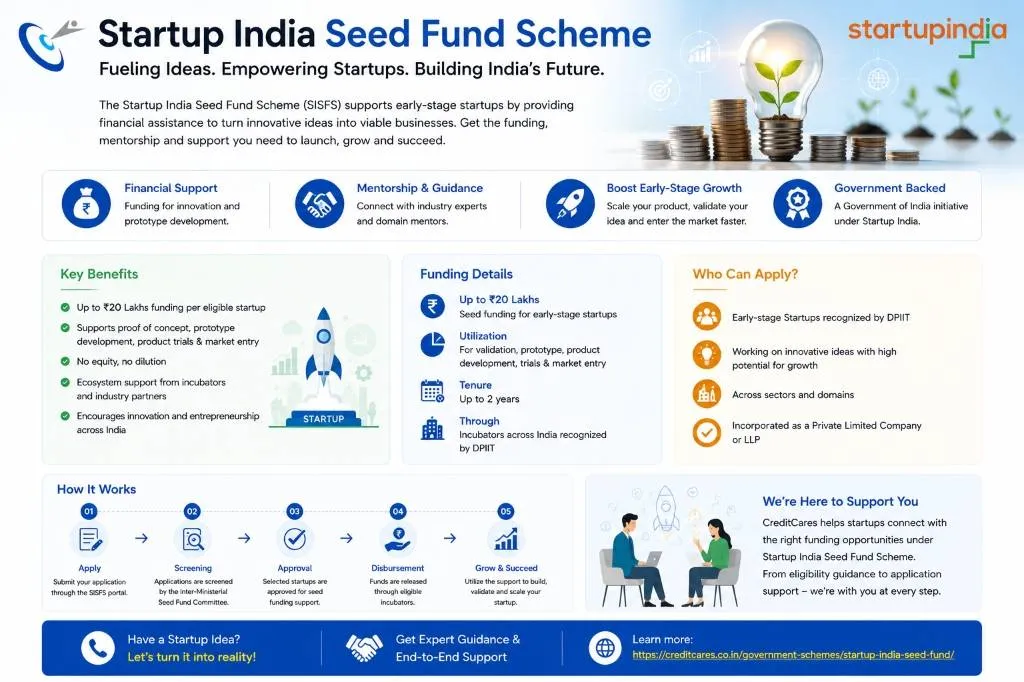
The Startup India Seed Fund Scheme (SISFS) is a Government of India initiative that provides early-stage startups with up to a ₹20 lakh non-repayable grant for prototype development, and up to a ₹50 lakh debt for market entry.
⚠️ Important Scheme Status Update (June 2026):
The final date for startup applications under SISFS was 31 May 2026. Incubators have until 30 June 2026 to complete 100% startup selection. If you have already applied, track your incubator communication closely — this is the disbursement window, not a new application window. Future cycles or a successor scheme may be announced by DPIIT (Department for Promotion of Industry and Internal Trade); bookmark this page for updates.
This is disbursed through a network of 300+ DPIIT-approved incubators nationwide, backed by a total corpus of ₹945 crore. Eligibility requires DPIIT recognition, incorporation within 2 years, 51% Indian promoter shareholding, and no more than ₹10 lakh in prior government monetary support.
Proof of concept is the single hardest stage to fund. Angel investors want traction. Banks want collateral. And venture capital is not built for a ₹20 lakh prototype build. The result: over 90% of Indian startups that fail do so before ever reaching product-market fit — not because the idea was wrong, but because the money ran out at the critical validation stage.
That is exactly the gap SISFS was designed to bridge. Since its launch in April 2021 by Minister Piyush Goyal under the Startup India initiative, the scheme has committed funds to over 2,800 startups across 31 states and union territories. However, here is the number the brochure does not show: over 70% of applications are rejected at the very first screening gate — not for a weak idea, but for a paperwork technicality the founder could have fixed in an afternoon.
This guide covers everything a founder or finance advisor needs to know in 2026 — eligibility, funding structure, how the money actually moves, how to pick the right incubator, and the real reasons applications get rejected.
💡 Strategic Insight:
SISFS is not a grant you apply for with a pitch deck and a dream. The Incubator Seed Management Committee (ISMC) evaluating your application is revenue-focused in 2026 — they want to see that your core technical risk is already resolved, not that you are asking for money to figure out if the technology works. "We'll figure out monetisation later" is no longer accepted by evaluation committees.
What is the Startup India Seed Fund Scheme (SISFS)?
The Startup India Seed Fund Scheme is a central government programme that channels seed capital to early-stage startups through DPIIT-approved incubators, targeting the "valley of death" between idea validation and Series-A institutional funding — the stage where both banks and most angel investors typically step back.
The money does not flow directly from the government to startups. The route is: DPIIT → approved incubator → startup. Each approved incubator receives up to ₹5 crore from DPIIT, which it then disburses to selected startups through its own Incubator Seed Management Committee (ISMC). This structure means the incubator you choose is not just an administrative stop — it is your actual funder and evaluator.
| Scheme Metric | Figure |
|---|---|
| Total government corpus | ₹945 crore |
| Target beneficiaries | 3,600 entrepreneurs |
| Approved incubators | 300+ across India |
| Funds approved (as of January 2026) | ₹592 crore |
| Startups with committed funds (March 2026) | 2,800+ |
| Women-led startup allocation | ₹294 crore |
| States/UTs covered | 31 |
SISFS Eligibility Criteria 2026: Who Can Qualify?
To be eligible for the Startup India Seed Fund Scheme, a startup must meet every one of the following criteria without exception — missing even a single item disqualifies the application regardless of business potential.
| Eligibility Criterion | Requirement |
|---|---|
| DPIIT recognition | Mandatory — must have a valid DPIIT recognition certificate before applying |
| Incorporation age | Less than 2 years from registration date at the time of application |
| Entity type | Private Limited, LLP, or registered partnership (sole proprietorships and OPCs are not eligible) |
| Innovation requirement | Product, service, or business model must be technology-driven and genuinely innovative — copy-paste service models do not qualify |
| Indian promoter shareholding | Minimum 51% held by Indian promoters at the time of application |
| Prior government funding | No more than ₹10 lakh in monetary support from Central or State Government schemes |
| Sector | Open to all sectors; preference given to social impact, agriculture, biotech, health, water, energy, fintech, and defence |
What Counts Toward the ₹10 Lakh Government Funding Threshold — and What Doesn't
This is where many founders miscalculate their eligibility. The ₹10 lakh limit applies to monetary support, not all forms of government assistance.
These count toward the limit:
- Direct cash grants from central or state government startup schemes (e.g., BIRAC grants, MSME grants with a cash component)
These do NOT count and can be received in any amount without affecting eligibility:
- Prize money from competitions
- Subsidised workspace or incubation facilities
- Founder monthly allowance during incubation programmes
- Access to prototyping labs and equipment
- Mentorship or training support
For example, if a founder receives ₹5 lakh from a state scheme, but ₹2 lakh is allocated for lab access and only ₹3 lakh is a direct cash grant, they have only utilized ₹3 lakh of their ₹10 lakh threshold. If you have received any prior government support, declare it fully — incubators verify this during due diligence, and undisclosed prior funding is grounds for immediate rejection.
🔍 Insider Insight: The Four Rejection Traps the Scheme Guidelines Don't Mention
The official SISFS eligibility checklist is clear on paper. What it doesn't tell you is that the 2026 evaluation process has become heavily automated at the first gate — an algorithm screens applications for these "hygiene" factors before a human expert ever reads your pitch.
Trap 1: DPIIT category mismatch. If your DPIIT recognition certificate lists "E-commerce" but you are now building "AgriTech," the mismatch flags your application. Update your industry category on the Startup India portal before applying.
Trap 2: The 2-year clock is precise to the day. If your incorporation date is April 1, 2024, and you apply to an incubator on April 2, 2026, you are ineligible. There are no exceptions.
Trap 3: Asking for money to validate whether the technology works. SISFS is designed for startups that already have a prototype or an MVP (Minimum Viable Product) and need capital to reach market entry — not for idea-stage founders. The scheme for that earlier stage is NIDHI-PRAYAS. Applying for SISFS with only an idea on paper puts you in the wrong lane.
Trap 4: Incubator empanelment cap exhausted. Each approved incubator has a DPIIT-set cap — typically ₹5 crore. If a popular incubator has already disbursed its full allocation, your application sits indefinitely. Always check the "Funds available" field on the incubator dashboard before applying.
SISFS Funding Breakdown: ₹20 Lakh Grant vs ₹50 Lakh Debt
SISFS offers two distinct funding instruments targeting different startup stages. Applying for the wrong component — or without a clear rationale for which one you need — is a common rejection reason.
| Component | Maximum Amount | Instrument | Best Use |
|---|---|---|---|
| Proof of Concept / Prototype | ₹20 lakh | Non-repayable grant (milestone-based) | Prototype build, validation experiments, product trials |
| Market Entry / Commercialisation | ₹50 lakh | Convertible debentures or debt | Go-to-market launch, early scaling, commercialisation |
Grant terms:
Funds are released in tranches tied to defined milestones agreed at the time of the funding agreement — not as a lump sum. After each tranche, the startup must submit a Utilisation Certificate (UC) and progress report before the next tranche is released.
Debt terms:
- Interest rate: Not exceeding the prevailing RBI repo rate.
- Tenure: Maximum 60 months (5 years).
- Moratorium: Up to 12 months before repayment begins.
- Security: Completely unsecured — no promoter guarantees or third-party guarantees required.
A startup can receive both components, but not simultaneously — the grant is typically utilised first for prototype development, and the debt component follows when the startup is ready for commercialisation.
How to Apply for Startup India Seed Fund Scheme: Step-by-Step
Get DPIIT Recognition (if not already done)
Visit startupindia.gov.in → "Get Recognised" → upload incorporation documents and business description → download your DPIIT certificate. This is free and typically takes 2–7 working days.
Verify All Eligibility Conditions
Check your incorporation date, shareholding structure, prior government funding received, and ensure your DPIIT certificate's industry category matches your current business.
Research and Shortlist Three Incubators
Go to the SISFS portal, filter by sector and state, check "Funds available" for each, and look at their portfolio (IIT and IIM-affiliated incubators have the strongest track records for active disbursement).
Prepare Your Application
Compile the DPIIT certificate, Certificate of Incorporation, team KYC, bank statements, GST certificate, and a detailed pitch deck covering: problem statement, solution, market size, product status, revenue model, and milestone-based fund utilisation plan.
Submit Through the SISFS Portal
Log in with your DPIIT credentials → select your three incubators in preference order → fill the application form → upload documents → submit. You will receive an application reference number for tracking.
Pitch to Shortlisted Incubators
Shortlisted startups are called for a presentation before the ISMC — typically 10–15 minutes of pitch followed by Q&A. In 2026, ISMC panels are focused on unit economics (direct revenues and costs associated with a single customer), realistic milestones, and fund utilisation clarity.
How to Choose the Right SISFS Incubator (This Decision Shapes Your Outcome)
Not all 300+ approved incubators are equal. Some have been actively disbursing funds since 2021. Others received their allocation but have been slow to deploy or have already exhausted their corpus. Since you can only apply to three, the selection deserves real research.
IIT and IIM-affiliated incubators — including IIM-B NSRCEL (Bangalore), IIIT-H Foundation (Hyderabad), IIT Delhi's FITT, and IIT Bombay's SINE — are consistently the most active and best-managed SISFS partners. Their evaluation processes are rigorous but transparent, and their portfolio alumni are a meaningful asset for future fundraising conversations.
State-backed incubators like T-Hub (Hyderabad) and Kerala Startup Mission also have strong disbursement track records and are particularly well-suited for founders in those states or ecosystems.
Two practical checks before applying to any incubator:
- Does the incubator have a Success Stories page with funded startups in your sector? Domain alignment with your technology genuinely improves evaluation outcomes.
- Does the SISFS portal show "Funds available" for that incubator? If not, your application will stall regardless of quality.
You are not restricted to your home state. A founder based in Jharkhand can apply to an incubator in Karnataka — and many incubators accept virtual incubatees for the mentorship component.
Realistic Timelines and What Actually Causes Disbursement Delays
Official processing timeline:
- ISMC selection decision: within 45 days of application submission
- First grant disbursement: within 60 days of application submission
- Total application to money in bank: 6–16 weeks in most cases
One delay cause almost never mentioned in official guides: Utilisation Certificate (UC) format mismatch. DPIIT periodically issues updated UC templates through SISFS-EAC circulars. Incubators submitting a UC on an outdated template face automatic rejection by the DPIIT review system — and the tranche sits held until the correct format is resubmitted. Before your incubator submits any UC on your behalf, ask them to confirm they are using the current SISFS-EAC circular template.
If your disbursement stalls beyond the published timeline, you have a direct mechanism to escalate: an RTI (Right to Information) request submitted by Speed Post to the PIO at DPIIT, Udyog Bhawan, New Delhi — cost: ₹62 (₹10 IPO + ₹52 Speed Post). Responses typically arrive within 22 working days and have resolved UC-related stalls for multiple SISFS recipients.
SISFS vs NIDHI-PRAYAS vs TIDE 2.0: Which Scheme Fits Your Stage?
| Factor | SISFS | NIDHI-PRAYAS (DST) | TIDE 2.0 (MeitY) |
|---|---|---|---|
| Best for | MVP-stage, pre-revenue or early-revenue startups | Hardware/deep-tech prototyping (raw material phase) | Software/ICT founders needing EIR stipend + MVP grant |
| Maximum amount | ₹70 lakh (₹20L grant + ₹50L debt) | ~₹10 lakh | ~₹11 lakh (₹4L stipend + ₹7L grant) |
| Incubator required | Yes | Yes | Yes (MeitY-empanelled) |
| DPIIT recognition | Yes | Not mandatory | Not mandatory |
| Stage requirement | Working prototype or MVP | Idea → early prototype | Early MVP for ICT/AI/software |