
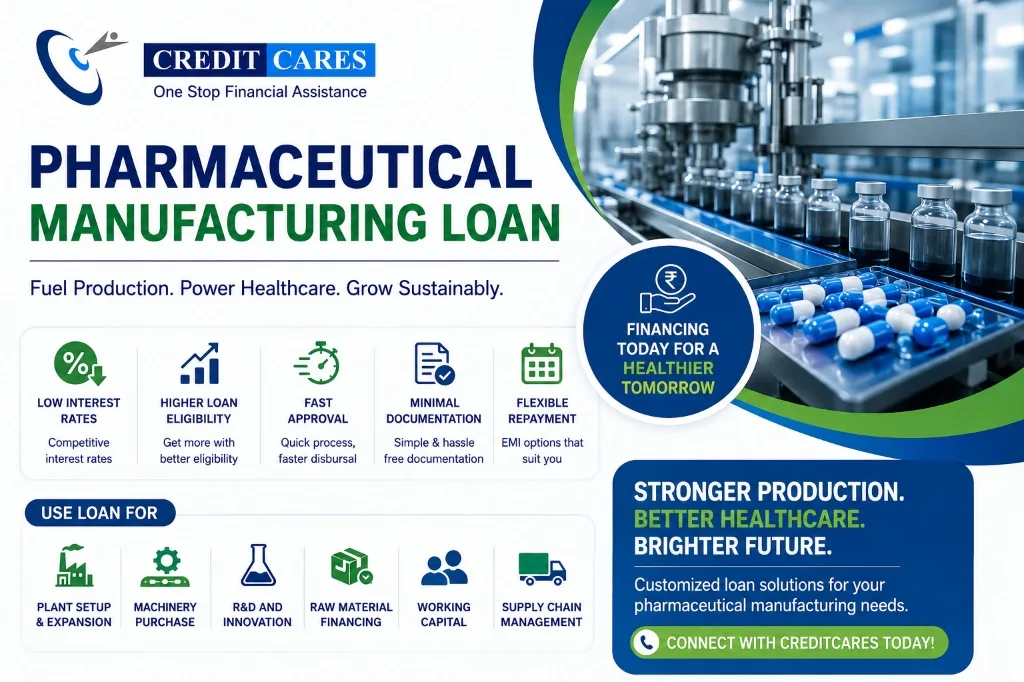
Pharmaceutical manufacturing sits high on lender priority lists — India makes a fifth of the world's generics, policy tailwinds (PLI schemes, API self-reliance push) are strong, and revenues are contract-anchored. But it's also compliance-dense lending: a pharma plant file is as much about Schedule M/WHO-GMP status, drug manufacturing licenses and pollution consents as it is about financials.
Funding structures span the lifecycle: greenfield plant projects (land, building, cleanrooms, HVAC, machinery) financed at 65–75% of project cost with construction moratoriums; brownfield expansion and new-line additions as term loans; machinery-specific finance for tablet, capsule, injectable and packaging lines; QC/QA laboratory equipment; and working-capital limits sized on raw material cycles and institutional receivables. Udyam-registered units can layer CGTMSE guarantee cover — now extending to ₹10 Crore — to reduce or eliminate collateral.
Loan-contract manufacturers (making for larger brands) underwrite beautifully on their agreements; own-brand makers lean on distribution depth. Either way, the difference between a generic business-loan appraisal and a pharma-literate one is worth percentage points — and that's the placement we do.
What pharma manufacturers fund
Greenfield plant setup
Land, civil, cleanrooms, HVAC and utilities to Schedule M / WHO-GMP standard.
Capacity expansion
New blocks, additional lines and shift-capacity debottlenecking.
Machinery
Granulation, compression, capsule filling, blister/packaging and injectable lines.
QC & compliance
HPLC/GC labs, stability chambers and GMP-upgrade capex.
Working capital
API/excipient inventory and 60–120 day institutional receivable cycles.
Product development
New formulations, dossier filings and regulatory approvals as part of project cost.
Interest rates & terms (2026, indicative)
| Lender type | Interest rate | Typical LTV / funding |
|---|---|---|
| Public sector banks | 9.50% – 11.50% p.a. | Project finance 65–75% of cost |
| Private banks | 10.00% – 12.50% p.a. | Composite term + WC limits |
| NBFCs / CGTMSE-layered | 10.50% – 13.00% p.a. | Collateral-light structures |
Rates are indicative market ranges for mid-2026 and vary by lender policy, credit profile and security. Final pricing rests with the sanctioning bank/NBFC.
Eligibility (typical)
- Drug manufacturing license (or credible licensing plan for greenfield)
- Schedule M/GMP-compliant facility or upgrade plan in project scope
- Pollution control consents (CTE/CTO); fire NOC
- 3+ years' vintage for expansion; promoter pedigree for greenfield
- Promoter margin 25–35% of project cost
- Contracts/orders supporting projected utilisation (strengthens file)
Documents required
- Drug manufacturing license; product permissions
- GMP/WHO-GMP certificates; PCB consents
- Project report with plant layout, machinery list & cost sheet
- 3 years' audited financials, ITRs, GST returns
- 12 months' banking; existing facility sanctions
- Loan/contract manufacturing agreements & order book
Manufacturing Loan EMI Calculator
Indicative only — final rate and eligibility are decided by the lender based on your profile and security.
How CreditCares gets you sanctioned faster
Profile & lender match
We map your financials and security to the lenders — from our 80+ bank & NBFC panel — most likely to approve on the best terms.
Bank-ready file
Financials, projections, property/KYC papers structured exactly the way credit teams want to see them.
Negotiation & follow-up
We place the file with multiple lenders, negotiate rate, LTV and fees, and keep approvals moving.
Sanction & disbursal
Terms finalised, sanction issued, funds disbursed — tracked end to end by one team.
Frequently asked questions
Can a loan-license/contract manufacturer get funded on its agreements?
Yes — and often better than own-brand makers, because contracted volumes make revenue projections verifiable. Multi-year agreements with reputed brands anchor both term-loan appraisal and working-capital sizing.
Does the Schedule M upgrade deadline affect financing?
It creates a financing need — revised Schedule M compliance requires HVAC, documentation-system and facility upgrades that many MSME units must fund. Lenders view GMP-upgrade capex favourably (it protects their borrower's license), and we structure it as term loans, often CGTMSE-covered for eligible units.
Is collateral-free funding realistic for a pharma factory?
Within limits, yes. CGTMSE guarantee cover now extends to ₹10 Crore for eligible MSMEs, letting lenders waive collateral on that portion. Larger projects blend covered and secured tranches. The unit still must pass full credit appraisal — the guarantee replaces collateral, not viability.
How is working capital sized for a pharma manufacturer?
On the operating cycle: raw material holding plus WIP plus finished stock plus receivables (institutional buyers stretch 60–120 days), minus supplier credit. Pharma cycles commonly justify limits of 25–35% of turnover — higher than most manufacturing — if documentation supports it.
Do PLI or state incentives affect my loan?
They strengthen it. PLI-linked revenue visibility, state capital-investment subsidies and interest subventions (where applicable) all improve project DSCR. We reflect eligible incentives in the financial model — lenders give credit for documented, sanctioned benefits.
Related loan products
Pharma Machinery Loan
View →Medical Device Manufacturing Loan
View →Industrial Property Loan
View →Pharma & Healthcare Loans — hub
View →Get the right lender, not just any lender
Share a few details and a CreditCares expert will map your eligibility across 80+ banks & NBFCs — free, confidential, no obligation. Since 2012 · ₹2,000 Cr+ facilitated · 4.9★ on Google.
Get my free eligibility check Call +91 98300 38870Disclaimer: CreditCares is a private loan consultancy / DSA — not a bank, NBFC or government body. Interest rates, LTV and eligibility parameters shown are indicative market ranges for 2026 and change with lender policy. Loan approval, pricing and terms rest solely with the sanctioning bank/NBFC. Tax notes are general summaries — consult a Chartered Accountant before claiming deductions.