
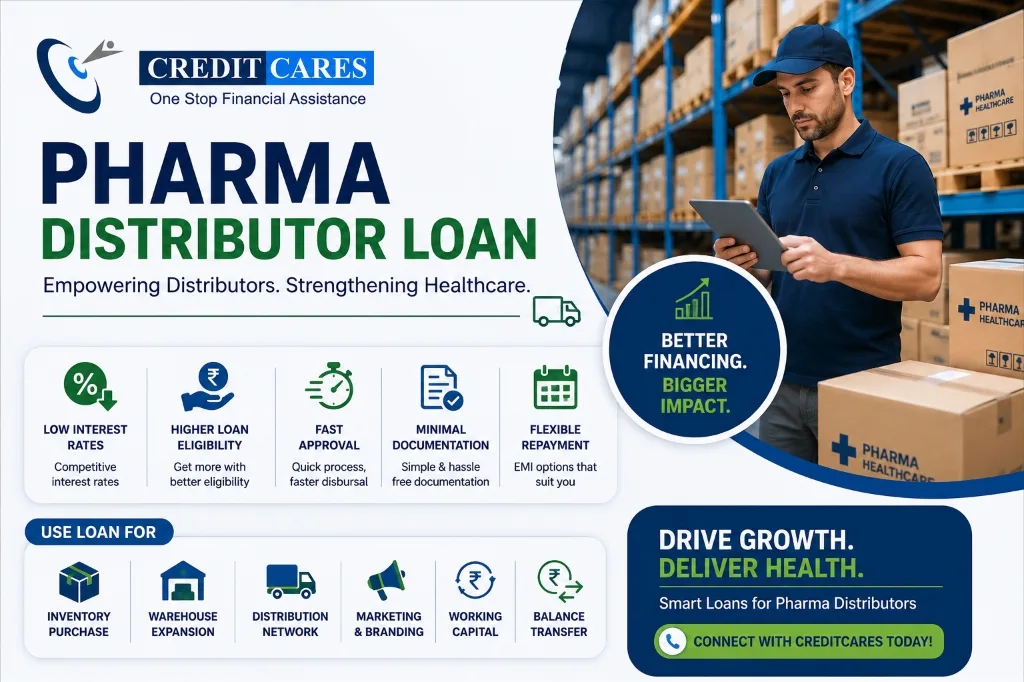
Pharma distribution is a working-capital business wearing a logistics coat: margins of 6–10% at wholesale, stock breadth demanded by companies above and chemists below, and a cash conversion cycle that stretches 45–90 days between paying the company and collecting from the market. Growth is bought with balance sheet — which is exactly what distributor finance provides.
The core products: cash-credit/OD limits sized on stock plus book debts; channel-financing lines under pharma companies' distributor programs (often at subsidised rates the company negotiates); invoice discounting against institutional and chain-pharmacy receivables; and term loans for godown expansion, cold-chain and delivery infrastructure. C&F agents — who hold company stock rather than own it — are underwritten on commission income and infrastructure instead of inventory.
Lenders read distribution files through drug-license class (20B/21B), the principals you carry (distributing established companies de-risks the book), receivable ageing and banking hygiene. We package those signals properly and place files with the banks and NBFCs whose channel-finance and wholesale-trade programs fit your structure.
What distributors fund
Stock expansion
Carrying more divisions, more principals and deeper chronic-therapy inventory.
Receivable float
Bridging the 45–90 day gap between company payments and market collections.
New agencies
Security deposits and opening stock when signing new company distributorships.
Godown & cold chain
Warehouse expansion, cold rooms for biologics and vaccine-grade storage.
Logistics
Delivery vehicles and route infrastructure for sub-stockist networks.
Institutional supply
Financing government and hospital tender receivables with long cycles.
Interest rates & terms (2026, indicative)
| Lender type | Interest rate | Typical LTV / funding |
|---|---|---|
| Bank CC/OD limits | 10.00% – 12.00% p.a. | 20–30% of turnover, stock + debtors |
| Company channel-finance programs | 9.00% – 12.00% p.a. | Principal-negotiated; invoice-linked |
| NBFC working-capital programs | 12.00% – 14.00% p.a. | Banking-surrogate, fast limits |
Rates are indicative market ranges for mid-2026 and vary by lender policy, credit profile and security. Final pricing rests with the sanctioning bank/NBFC.
Eligibility (typical)
- Wholesale drug license (20B/21B) with vintage
- Distribution agreements with pharma companies
- Business vintage 3+ years; GST-documented turnover
- Receivables ageing within acceptable norms
- Banking reflecting genuine trade volumes
- Acceptable CIBIL/CMR of entity and promoters
Documents required
- Wholesale drug license & GST registration
- Distribution/C&F agreements with principals
- 2–3 years' ITRs & financials; GST returns
- 12 months' banking (all accounts)
- Stock statement & debtor ageing list
- Existing limit sanction letters if any
Distributor Loan EMI Calculator
Indicative only — final rate and eligibility are decided by the lender based on your profile and security.
How CreditCares gets you sanctioned faster
Profile & lender match
We map your financials and security to the lenders — from our 80+ bank & NBFC panel — most likely to approve on the best terms.
Bank-ready file
Financials, projections, property/KYC papers structured exactly the way credit teams want to see them.
Negotiation & follow-up
We place the file with multiple lenders, negotiate rate, LTV and fees, and keep approvals moving.
Sanction & disbursal
Terms finalised, sanction issued, funds disbursed — tracked end to end by one team.
Frequently asked questions
What limit can a ₹10 Crore-turnover distributor expect?
Working-capital limits typically land at 20–30% of documented turnover — ₹2–3 Crore in this case — sized on your stock holding plus receivables minus company credit. Channel-finance lines under your principals' programs can add capacity on top of that.
What is channel finance and should I use it?
Channel finance is credit arranged under a pharma company's program with a partner bank/NBFC — the lender pays the company for your invoices, you repay on extended terms. Rates are often subsidised and limits generous because the principal vouches for the channel. If your companies offer it, it's usually your cheapest money; we help you layer it with your own limits.
How are C&F agents funded differently from stockists?
C&F agents hold company-owned stock, so inventory-based limits don't apply. Lending is against commission income, infrastructure (godown, staff, systems) and the C&F agreement itself — typically term loans for warehouse capex plus modest working capital.
Do government-tender receivables qualify for financing?
Yes — institutional receivables from government supply (long but reliable cycles) can be financed through invoice discounting or included in book-debt limits, usually with a longer cover period and a margin haircut reflecting the cycle.
My turnover is large but book profits are thin — is that a problem?
It's the norm in distribution and lenders know it. Appraisal weighs turnover, churn, banking and receivable quality more than margin. Thin profit with clean banking funds readily; thin profit with cash-ledger opacity doesn't. Documentation, again, is the differentiator.
Related loan products
Pharmacy & Medical Store Loan
View →Healthcare Working Capital
View →Warehouse & Godown Loan
View →Pharma & Healthcare Loans — hub
View →Get the right lender, not just any lender
Share a few details and a CreditCares expert will map your eligibility across 80+ banks & NBFCs — free, confidential, no obligation. Since 2012 · ₹2,000 Cr+ facilitated · 4.9★ on Google.
Get my free eligibility check Call +91 98300 38870Disclaimer: CreditCares is a private loan consultancy / DSA — not a bank, NBFC or government body. Interest rates, LTV and eligibility parameters shown are indicative market ranges for 2026 and change with lender policy. Loan approval, pricing and terms rest solely with the sanctioning bank/NBFC. Tax notes are general summaries — consult a Chartered Accountant before claiming deductions.