
PSB 59-Minute Loan: Eligibility, Process & Market Comparison (2026)
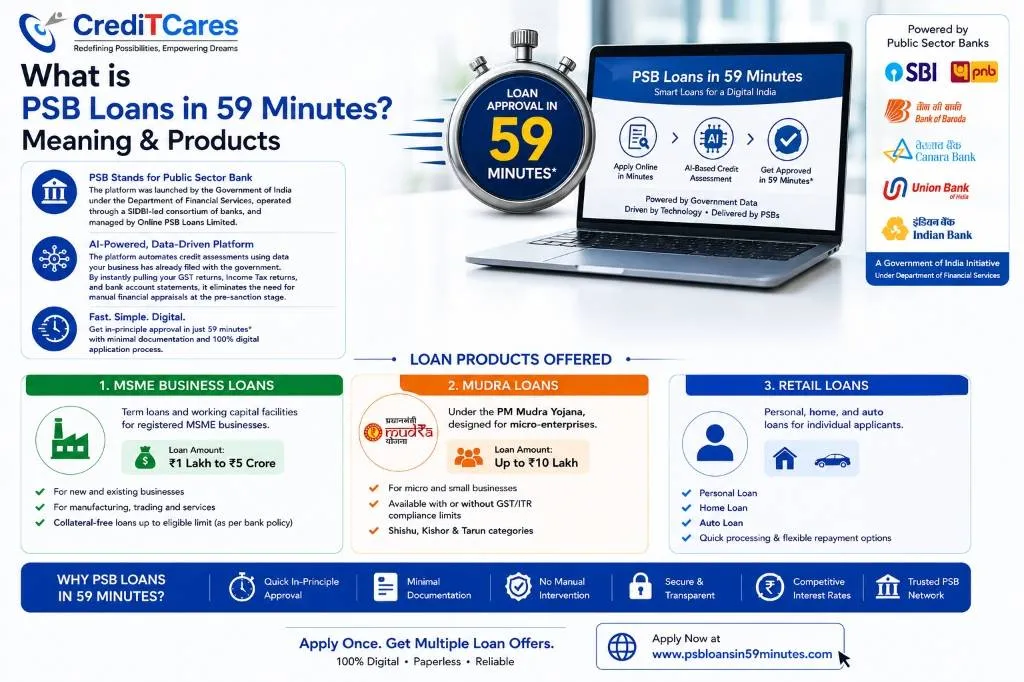
For small and medium enterprises in India, securing rapid capital can make the difference between expansion and missed opportunities. The PSB Loans in 59 Minutes portal provides a structured digital gateway to public sector and private institutional credit, matching tax-compliant businesses with willing lenders within minutes.
How the PSB 59-Minute Loan Works: The Step-by-Step Process
The portal splits your loan journey into a rapid digital phase and a thorough physical verification phase:
-
1
Portal Registration
⏱️ Time: 5 mins
Visit the official portal (psbloansin59minutes.com) and create your business profile using a verified mobile number and email ID.
-
2
Business Details Entry
⏱️ Time: 10 mins
Input your business PAN, Udyam/MSME registration data, and your active GST login credentials.
-
3
Financial Data Upload
⏱️ Time: 15 mins
Provide your Income Tax Returns (ITR) specifically in XML format and upload your last 6 months of bank statements in PDF format. The system auto-fetches your GST data simultaneously.
-
4
Loan Selection
⏱️ Time: 5 mins
Choose whether your business needs a term loan or an ongoing working capital facility, then input your required loan amount.
-
5
Algorithmic Assessment
⏱️ Time: 15-59 mins
The portal’s automated engine analyzes your banking data, compliance track record, and tax history to match you with willing lenders.
-
6
In-Principle Approval
⏱️ Time: Instant
The platform generates an official in-principle approval letter listing eligible banks alongside their indicative interest rates and terms.
-
7
Lender & Branch Selection
⏱️ Time: 5 mins
Review the matched bank options, select your preferred financial institution, and choose your local neighborhood branch.
-
8
Bank Credit Review
⏱️ Time: 7-15 working days
The digital phase ends here. You visit the chosen branch with physical copies of your documents. The bank performs standard underwriting, background checks, and physical site verifications.
-
9
Final Sanction & Disbursement
⏱️ Time: 7-8 working days
Once the credit committee approves your file, the loan is formally sanctioned, loan agreements are executed, and funds are disbursed to your current account.
Market Comparison: PSB 59 Minutes vs. Alternative Schemes
Understanding how this portal compares to traditional routes helps you choose the fastest path to capital:
| Feature | PSB 59 Minutes Portal | Traditional MSME Bank Loan | Mudra Loan Scheme |
|---|---|---|---|
| In-Principle Turnaround | 59 minutes | 20–30 business days | 7–14 business days |
| Loan Amount Range | ₹1 lakh to ₹5 crore | ₹1 lakh to ₹50 crore+ | Up to ₹20 lakh (Tarun Plus) |
| Collateral Mandate | Optional (Up to ₹5 crore via CGTMSE) | Required for most loans over ₹10 lakh | No collateral required |
| Starting Interest Rates | From 8.50% p.a. | 8.50% to 14.00% p.a. | 8.50% to 12.00% p.a. |
| Tax Compliance Norms | GST and ITR data required | Full physical tax audits required | Not mandatory for entry tiers |
| Minimum Credit Score | CIBIL / CMR of 650+ | CIBIL of 700 to 750+ | CIBIL of 650 (flexible) |
When PSB 59 Minutes Wins: If your business is fully tax-compliant, possesses over 12 months of clean banking data, and needs between ₹10 lakh and ₹5 crore, this portal offers the fastest route to public sector institutional credit.
When to Consider Mudra Instead: If your business operates below the formal GST threshold, has less than a year of operational history, or requires a smaller facility under ₹20 lakh without rigorous compliance documentation, the Mudra scheme is generally more accessible.
Complete Eligibility Criteria
To successfully pass the portal's automated credit filters, your enterprise must satisfy the following conditions:
- Business Classification: Must qualify as an MSME under the MSMED Act based on updated investment in plant, machinery, and annual turnover metrics. A valid Udyam certificate is highly recommended.
- Business Vintage: A minimum of 12 months of active, uninterrupted business operations, proven via consistent transaction records in your primary bank account.
- GST Compliance: Active GST registration is strongly preferred. While non-GST businesses can manually input sales data, the majority of public sector lenders on the portal restrict their offers to GST-registered entities, significantly reducing your choices if you lack a GSTIN.
- Income Tax Compliance: At least 1 year of filed ITR is mandatory (3 years preferred). The file must be uploaded using the official XML data format downloaded from the e-filing portal—standard scanned PDFs will cause an application error.
- Banking Track Record: The last 6 months of business bank statements must be uploaded via PDF or net-banking integration. The account must show steady business credits that align naturally with your declared sales and turnover.
- Credit Health: A CIBIL or Credit Monitoring Report (CMR) score of 650 or above is required. Scores below this benchmark usually cause the portal to yield zero matching lenders.
When an application fails on the portal, the algorithm rarely explains why; it simply states that no lenders match your profile. These are the top four underlying reasons for these "silent rejections":
- ITR vs. GST Turnover Discrepancies: The platform’s algorithm automatically cross-checks your total annual GST filings against the turnover declared in your Income Tax Returns. In major trading hubs like Kolkata and across West Bengal, many business owners filing taxes under Section 44AD (presumptive taxation) intentionally report lower net profits on their ITR for tax optimization, while their GST returns show high gross revenue. The algorithm flags this mismatch as a financial inconsistency and reduces your eligible loan amount or declines the file entirely.
- Incorrect ITR File Formats: Many applicants attempt to upload their standard scanned PDF tax acknowledgments. The portal is explicitly hardcoded to read data structures inside an XML format file. You must log into the Income Tax e-filing dashboard, navigate to "View e-Filed Returns," and download the technical XML data file separately before starting your application on the portal.
- Unsupported Business Bank Accounts: The platform relies on automated bank integrations to read statement histories. If your primary corporate current account is held with a cooperative bank, a regional rural bank (RRB), or a smaller private financial institution, it may not be supported by the portal's net-banking scanner. This limits the algorithm's ability to verify cash flows, narrowing your lending options.
- Group or Promoter Credit Flags: Because the algorithm initiates an automated credit bureau check on all individual partners, directors, and proprietors, even a minor personal credit card default or a delayed personal vehicle loan EMI by an individual promoter can cause the system to reject the entire corporate application.
Comprehensive Document Checklist
Required for Digital Portal Uploads
- Official Business PAN card.
- Promoter, director, or partner identity credentials (PAN and Aadhaar).
- Active GSTIN along with valid GST login credentials for auto-fetching capabilities.
- Income Tax Returns in XML data format for the last 1 to 3 fiscal years (ITR-3, ITR-4, ITR-5, or ITR-6 as applicable).
- Business bank account statements covering the most recent 6-month period in a clean PDF format.
- Valid Udyam/MSME registration certificate.
Required for the Physical Bank Verification Stage
- Signed hard copies of your business KYC, address proofs, and promoter identity credentials.
- Physical copies of your last 3 years of audited financial statements (Balance Sheets and Profit & Loss statements signed by a Chartered Accountant).
- Sanction letters alongside up-to-date statements of account for any existing commercial credit lines.
- Physical title deeds and property records if you opt to pledge collateral for lower interest tiers.
Interest Rates & Hidden Fee Structures (2026)
Interest rates are set individually by each participating bank based on the risk profile generated by the portal's algorithm. Below are current indicative pricing metrics:
| Financial Institution Category | Indicative Interest Rates (p.a.) | Standard Processing Fees |
|---|---|---|
| Public Sector Banks (SBI, PNB, BoB, BoI) | 8.50% – 10.50% | 0.1% to 1.0% of the loan amount |
| Private Sector Banks (Axis, HDFC, ICICI) | 10.00% – 12.00% | 0.5% to 1.5% of the loan amount |
| Non-Banking Financial Companies (NBFCs) | 11.00% – 16.00% | 1.0% to 6.0% of the loan amount |
The CGTMSE Annual Guarantee Fee
If you secure a collateral-free loan up to ₹5 crore backed by the Credit Guarantee Fund Trust for Micro and Small Enterprises (CGTMSE), an annual guarantee premium ranging from 0.37% to 1.35% of the sanctioned loan value is charged by the underwriting institution. Lenders frequently deduct this fee upfront from the initial disbursement amount. Always ask your bank branch manager for an explicit breakdown of the CGTMSE fee tier applied to your credit line before signing the final loan agreement.
Frequently Asked Questions (FAQs)
Disclaimer: This guide is intended solely for general educational purposes and does not represent formal financial, legal, or legal tax advisory services. Credit eligibility parameters, interest rates, platform processing structures, and transactional charges are determined independently by participating lending institutions and the portal's algorithm, and are subject to immediate revision. CGTMSE coverage ceilings and premium schedules strictly follow current regulatory frameworks as of June 2026. CreditCares operates as an independent financial advisory consultancy and holds no official corporate affiliation with SIDBI, Online PSB Loans Limited, or any partner banking organization.